
The oracle gap
Something is visibly wrong in the AVLT/USDT0 market on Morpho HyperEVM.
Based on currently available public data, a large number of borrower positions appear economically impaired, or under water, if AVLT is valued at its traded on-chain market price. Yet those positions are not being liquidated. Why? The price used by Morpho for liquidation is not the same as the price at which AVLT is actually trading.
The Morpho AVLT/USDT0 market currently shows an oracle price of approximately $1.09 for AVLT, while DefiLlama’s referenced market price is materially lower, around $0.67-$0.70. The market is also shown at 100% utilization. In practical terms, the lending market is full, liquidity is absent, and the collateral valuation used for health checks is well above the price at which liquidators can realistically exit the collateral.
In layman terms? You mortgaged your $100 Monopoly house to get $90, a fire heavily damaged your house, and now it is only worth $50. It does not make sense to pay back the debt to get back the house because it is now worth much less.

Why liquidations fail
Morpho liquidations conceptually work in the same way. A borrower posts collateral, borrows against it, and becomes liquidatable once the position crosses the market’s liquidation loan-to-value threshold. But liquidations are executed using the market oracle price. The liquidator repays debt and receives collateral valued using that oracle, plus a liquidation incentive.
In normal conditions, this works. The house value has not dramatically changed. If the oracle price is close to the traded market price, the mechanism is self-correcting: unhealthy positions are liquidated, bad debt is contained, and lenders remain protected.
That is not what is happening here. The house is on fire. If the oracle says AVLT is worth $1.09, but the market is closer to $0.67, the liquidation incentive is not enough. Based on the currently displayed Morpho liquidation penalty, a liquidator would effectively be acquiring AVLT at a value far above the traded market price.
In layman terms, liquidators would pay almost full price for the burned house. That makes no sense, and it explains why liquidations are not happening.
The positions may look liquidatable in theory, but they are not liquidatable in economic reality. No rational liquidator wants to repay good USDT0 in exchange for collateral that the market values materially lower than the oracle. The protocol says the collateral is worth more than $1, while the market says it is worth much less. Liquidators, and we, care about the second number.
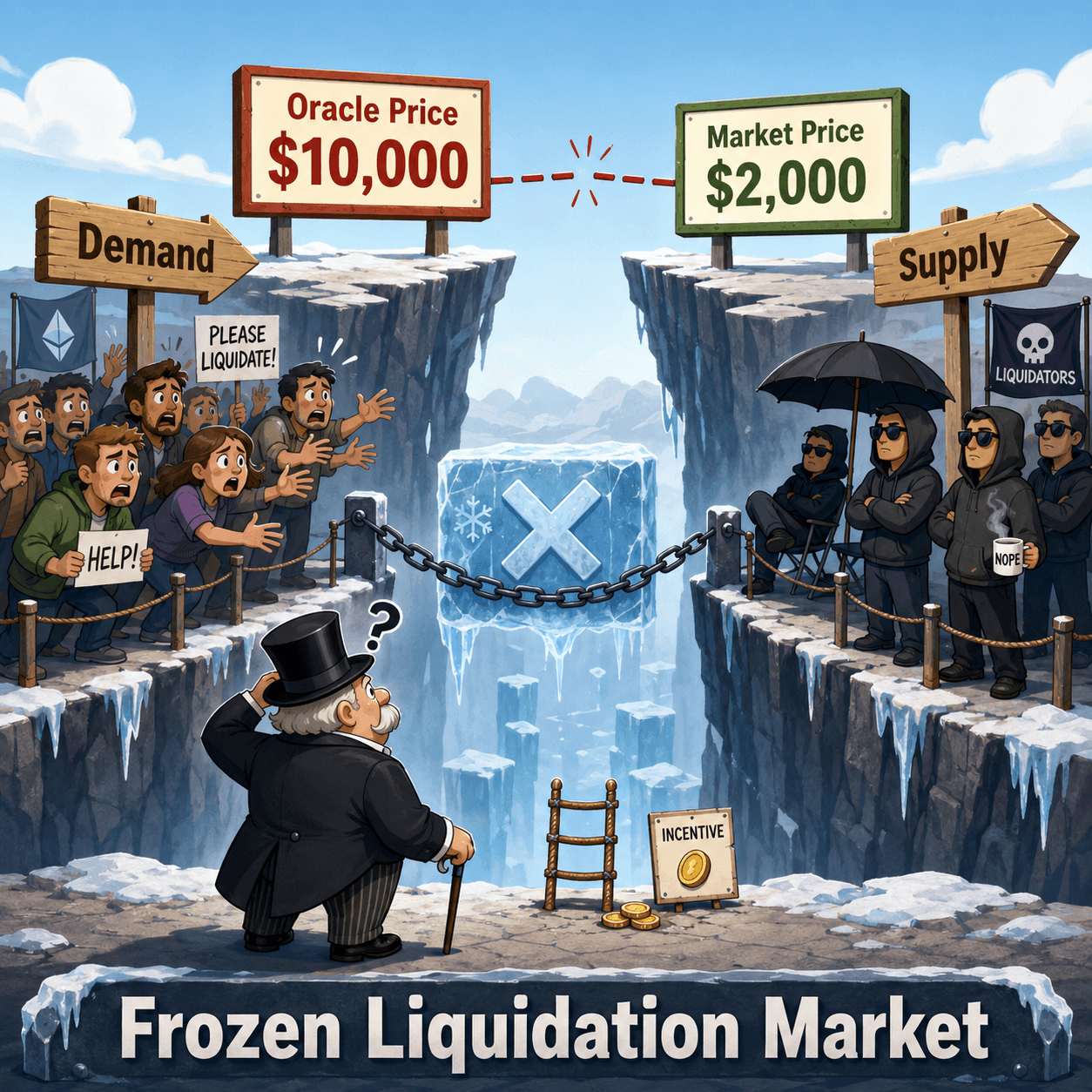
A frozen liquidation market
When borrowers are undercollateralized on a market-price basis, but cannot be profitably liquidated because the oracle remains too high, the loss does not disappear. It sits inside the market. Interest continues to accrue. Utilization remains elevated. Liquidity becomes harder to access.
If the oracle eventually adjusts downward, or if liquidations occur into insufficient collateral value, the economic loss falls on suppliers in that market. Morpho’s own risk documentation identifies bad debt risk as a lender risk where collateral can fall below the borrowed amount before liquidators can close the position.
This is where the market failure appears. There is clear demand from borrowers or distressed position holders who want out. There is also theoretical supply from liquidators who would normally step in to close unhealthy loans. But the clearing price does not work. The oracle-defined liquidation price is too high, the traded price is too low, and the protocol incentive is insufficient to bridge the gap.
The result is a frozen liquidation market.
Why OTC liquidity matters
Some users are now reportedly looking for external incentives or OTC solutions to make liquidators whole. Economically, that makes sense. If the protocol liquidation bonus is not enough, the missing incentive has to come from somewhere else.
But once this activity moves away from transparent on-chain liquidation into private OTC channels, execution risk increases. Users need to find counterparties, negotiate terms, assess settlement risk, and avoid scams. Recourse is limited. Speed matters, but so does counterparty quality.
This is exactly the kind of situation where specialist liquidity providers can be useful. Third Eye and PAXTIBI can review AVLT positions, Morpho borrower exposure, and related OTC opportunities case by case. That may include purchasing the position, facilitating a structured OTC exit, or providing a bid for distressed exposure.
What's inside AVLT?
AVLT is described by Altura as a vault-share asset. The question is therefore not only “where does AVLT trade?” but “what does AVLT actually represent, and how quickly can the underlying assets be realized?”
This becomes more sensitive because of the reserve composition. Public reporting and market discussion have focused on Altura’s exposure to Inessa Holdings, which comprised more than 60% of its reserves. Inessa describes itself as a firm managing commodities and physical assets, but not many other details are available online. It is too vague for our liking.
For an on-chain lending market, the relevant questions are asset-level proof, custody, redemption mechanics, settlement timing, enforceability, counterparty risk, and whether the asset value can be independently verified. A website, broad business description, or self-reported accounting price is not the same thing as liquid, transparent, on-chain collateral.
Altura has reportedly begun an orderly wind-down of vault operations following heavy redemption pressure. Public reports state that Altura processed more than $5 million of redemptions within 24 hours, with cumulative redemptions later exceeding $8.5 million USDT, and that the platform was unwinding exchange, private credit, and RWA positions to return funds to users over time. The same reports also state that Altura denied any hack or insolvency and said certain markets were not directly affected.
For tokenized vault assets, private credit exposure, and real-world asset collateral, the standard must be higher. The market needs independent verification, credible reserve reporting, clear redemption mechanics, and oracle design that reflects executable value rather than optimistic accounting value.
Until then, the AVLT/USDT0 market is a live case study in what happens when a lending protocol relies on a price that liquidators cannot monetize.
For affected users seeking a confidential OTC exit or liquidity review, Third Eye and PAXTIBI can assess positions on a case-by-case basis. Reach out to us for a confidential chat.
Update (21 August 2026)
The original problem was that lenders were holding collateral nobody would buy. Now the cash exists, but it is stuck in an unknown bank account. Or is it?
- Altura spent July selling off what was left in the vault. By 23 July it said all the money was back and only one step remained: turn the cash into USDT and pay everyone out, planned for 31 July.
- That did not happen. On 28 July Altura said its bank had frozen the account holding the money, about £16.4 million, while the bank carries out a review. Altura has not named the bank, has not said why, and has not given a new payout date.
- AVLT kept falling. July snapshots from CoinMarketCap and Etherscan show it around $0.31 to $0.32, down from $0.67 to $0.70 when this was first written.
- The Morpho lending market for AVLT no longer shows up in the Morpho app.
Sources
- DefiLlama AVLT token dashboard
- Morpho FAQ on lending, borrowing, and liquidation risks
- Altura says £16.4M bank account restricted during vault wind-down
- Altura blames restricted bank account for delays in final vault redemptions
- Altura update on X
- Altura Vault on CoinMarketCap
- AVLT address on Etherscan
Written by Federico Natali | Co-Founder & Partner at @PAXTIBI_xyz and @thirdeye_fund