
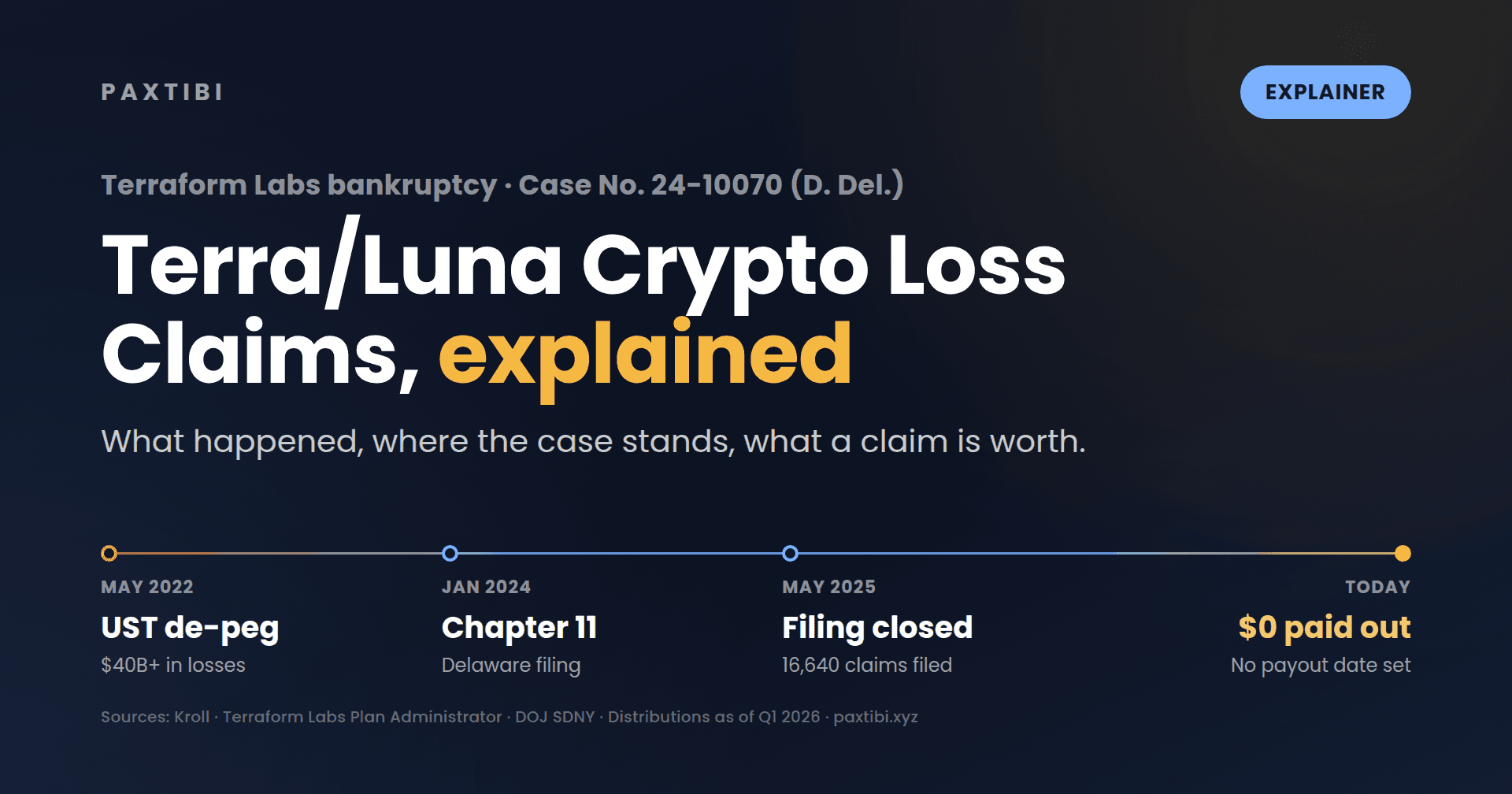
If you held LUNA, UST, or another eligible Terra ecosystem token when the system collapsed in May 2022, your route to bankruptcy recovery is a Crypto Loss Claim. Filing has closed, and an accepted claim is not a promise to repay your loss in full. Here is what happened, what the cited filings establish, and how to think about the amount and timing of a possible recovery.
Key facts
- UST lost its dollar peg in May 2022; the collapse caused more than $40 billion in investor losses, according to the DOJ.
- Crypto Loss Claims seek recovery from the Terraform Wind Down Trust in Delaware Case No. 24-10070.
- The late-filing window ended November 24, 2025 at 11:59 p.m. Eastern; the portal closed November 25.
- The allowed claim amount is not the payout. The cited FAQ does not set a recovery percentage or payment date.
Sources: DOJ, Docket 1177, and Kroll FAQ.
The claims figures below are a February 17, 2026 snapshot. The financial report covers the quarter ended March 31, 2026. These dated records do not establish the position on every subsequent date; check the official case website for later notices.
What actually happened to Terra/Luna
Terra’s ecosystem relied on UST, an algorithmic stablecoin designed to hold a $1 peg through a mint-and-burn mechanism with its sister token LUNA. In May 2022, UST lost that peg. The mechanism expanded LUNA’s supply as holders tried to exit, accelerating a collapse in its price and confidence in the ecosystem. The DOJ describes more than $40 billion in investor losses. The original tokens are now generally known as USTC and LUNC, distinct from the newer LUNA token.
Terraform Labs, the Singapore-based company behind the protocol, filed for Chapter 11 in Delaware on January 21, 2024, while facing the SEC’s civil fraud case. The bankruptcy subsequently moved into a wind-down process. Sources: DOJ account of the collapse and SEC investor information.
What a Crypto Loss Claim is and how it was calculated
Terraform Labs was a software developer rather than an exchange holding customer deposits. A Crypto Loss Claim is a claim for eligible losses against the bankruptcy estate. It is not a request for a custodian to return the coins in your account.
In simplified terms, the CLC Procedures calculate the cost of Eligible Loss Cryptocurrency acquired before May 13, 2022, less the defined Crypto Earnings through the January 21, 2024 Petition Date. Those deductions include specified profits monetized before May 7, 2022, value received after that date, and monetized airdrops. Eligibility and the treatment of individual transactions are governed by the procedures, not simply by the amount originally invested.
The administrator uses the evidence submitted to issue an Initial Determination. Accepting it fixes the claim amount and is irrevocable. A claimant who disagrees must use the time-limited dispute process before acceptance; that process is not a way to reopen an amount already accepted. The allowed amount is the basis for calculating a share of distributions, not the amount a claimant is guaranteed to receive. See the CLC FAQ and procedures on Kroll.
Where the case stands in the cited filings
Filing Deadlines
The original extended bar date was May 16, 2025. A later, court-authorized filing window ran from October 1 through November 24, 2025, and the portal closed November 25. Anyone seeking to file outside the permitted window would need relief from the bankruptcy court; contacting a claim buyer does not reopen filing.
Initial Determinations
The Third Status Update describes three distinct deadlines. Claimants have 30 days to accept or dispute their Initial Determination. For disputed claims, it describes a deadline to submit Supplemental Evidence 60 days from receipt of the Initial Determination. After a Final Determination, a claimant has 90 days to file an objection with the court. Failure to accept or dispute within the initial window can result in deemed acceptance. Follow the dates in your own notice and the governing procedures.
Claims Review Snapshot
As of February 17, 2026, the administrator reported 16,640 submitted forms, 8,449 Initial Determinations with approximately 87% accepted, 3,760 requests for additional information, and 3,129 claims awaiting individualized review. The submitted-form total includes forms subsequently replaced, withdrawn, or voided as duplicates. No Final Determinations had yet been issued on disputed Initial Determinations. These are historical figures from Docket 1177.
Dissolution Extension
On December 26, 2025, the Plan Administrator moved to extend the deadline to dissolve Terraform Labs Pte. Ltd. and Terraform Labs Limited from December 31, 2025 to December 31, 2026. The motion cited ongoing reconciliation of more than 16,000 claims and the fact that distributions had not begun. Docket 1151 establishes the request; its attached proposed order does not establish that the court granted it. A dissolution deadline is not a promised payment date.
Where Do Kwon’s criminal case fits in
Do Kwon pleaded guilty in August 2025 and was sentenced on December 11, 2025 to 15 years in prison for wire fraud and conspiracy. He was also ordered to forfeit more than $19 million in proceeds. That sentence does not trigger a distribution by the bankruptcy estate. See the DOJ sentencing announcement.
The SEC’s separate civil judgment requires Kwon to transfer at least $204,320,196 to the Terraform bankruptcy estate for harmed investors. That is an obligation to transfer assets, not proof that the entire amount is already available as cash for distribution. See the SEC’s explanation for investors.
The criminal case may also offer a separate route to compensation: the DOJ describes a victim remission process once property has been finally forfeited. That process has its own eligibility conditions and is separate from the bankruptcy. The prison sentence alone does not set the amount or timing of either recovery. See the DOJ victim information page.
How much will you actually get, and when?
Kroll’s FAQ says the recovery percentage cannot yet be determined: it depends on the total allowed claims and funds available for distribution. Your Crypto Loss Amount therefore should not be read as a payment quote.
The Q1 2026 report, Docket 1216, contains $0 and 0% entries for creditor classes in Part 3. Its global notes also say that zero can represent information that is unknown, not yet determined, or not applicable, and refer to reporting through the Wind Down Trust. We do not treat those entries alone as confirmation that Crypto Loss Claim holders received $0 through March 31, 2026. The December 2025 dissolution motion expressly said distributions had not begun at that earlier date.
The Plan excludes post-petition interest. The administrator also reserves the right to set a minimum cash distribution of at least $100 per Allowed Crypto Loss Claim. This is a possible distribution threshold, not a guaranteed $100 payment or a $100 minimum claim size; a small claim may receive nothing if its calculated distribution falls below the applicable threshold. See the Kroll FAQ.
- Estimated Recovery: Mid-single digits of allowed claim value (Paxtibi’s estimate, not an official recovery rate).
- Earliest Timing Scenario: Initial payments projected for 2028–2029 (Paxtibi’s potential scenario based on historical comparisons, not confirmed).
Paxtibi’s recovery estimate is based on the estate’s disclosed assets and the potential scale of claims. Asset realizations, litigation, expenses, and the final allowed claim pool can materially change the outcome. See our Terra Luna payment update for the asset analysis.
The timing scenario draws on the lengthy processes in other crypto bankruptcies. There is no Terraform filing cited here that establishes those years, the size of an initial payment, or a “not before” date. Payments could start earlier or later. For context, our Mt. Gox payment guide illustrates how long another crypto recovery process has lasted; it cannot predict Terraform’s timetable.
Why Terra/Luna is different from FTX
FTX operated an exchange, held customer assets, and had investments and other assets that its estate could realize. Terraform’s business was different: it developed software and did not hold customer deposits in the way an exchange did. Terraform claimholders depend on the assets available to its Wind Down Trust, including liquidation and litigation proceeds.
A recovery percentage from another bankruptcy cannot be carried across to Terra/Luna. Even a recovery above 100% of a dollar-denominated claim does not necessarily mean the return of the same coins or their current market value. For the separate FTX context, see our FTX payment update.
How to avoid Terra/Luna claim scams
The administrator’s warning is direct: “Neither the Plan Administrator, the Wind Down Trust, or their advisors will contact you by email, telephone call, or otherwise requesting account information.” See the official case guidance. The listed claim communications addresses include:
- Terraforminfo@ra.kroll.com
- TFL_CLC_Distributions@kirkland.com
- TerraAnswers@kirkland.com
- claims@terra.money
A familiar sender address alone does not authenticate an email. Open the official Kroll case website independently to check current contacts and reach the claim portal. Submit claim evidence through the official portal, not by replying to an unsolicited message.
Do not share private keys or seed phrases, or pay someone claiming a fee will expedite an estate distribution. Verify any unexpected request through the official case contacts before acting.
What you can do with an existing claim
Keep your claim records, monitor official notices, and respond to any outstanding evidence request by its deadline. If you prefer liquidity before the estate pays, Paxtibi reviews Allowed and pending Terra/Luna Crypto Loss Claims. Depending on the claim and agreed terms, an offer can provide upfront liquidity while preserving participation in future estate recoveries.
See how Paxtibi’s Terra/Luna claim review works →
Frequently asked questions
What happened to Terra/Luna in 2022?
UST lost its dollar peg in May 2022. The mechanism intended to support the peg expanded LUNA’s supply as confidence collapsed, driving down its price. The DOJ describes investor losses of more than $40 billion. The original tokens are now generally called USTC and LUNC.
Is Do Kwon’s 15-year prison sentence connected to creditor payouts?
The sentence does not trigger a bankruptcy payout. Do Kwon was sentenced on December 11, 2025 and ordered to forfeit over $19 million. Bankruptcy recovery depends on the Wind Down Trust’s available assets and allowed claims; the separate SEC judgment requires Kwon to transfer at least $204,320,196 to the estate. DOJ also describes a separate victim remission process after final forfeiture.
How much will I get back, and when?
Kroll’s FAQ says the recovery percentage cannot yet be determined. Your allowed claim amount is not your payout. Paxtibi’s working estimate is a recovery in the mid-single digits of allowed claim value, not an official rate. Small initial payments in 2028–2029 are a potential planning scenario based on other lengthy bankruptcies, not a confirmed schedule or an earliest possible payment date. Payments could arrive earlier or later.
Sources
- Kroll — Terraform Wind Down Trust Crypto Loss Claims
- Kroll — Crypto Loss Claims (Post-Bar Date) FAQ
- Docket 1177 — Third Status Update, February 17, 2026
- Docket 1216 — Q1 2026 Post-Confirmation Report, filed April 22, 2026
- Docket 1151 — Motion to extend the dissolution deadline, December 26, 2025
- DOJ — Do Kwon sentencing, December 11, 2025
- DOJ — Terraform fraud victim information and separate remission process
- SEC — Terraform and Do Kwon judgment: information for harmed investors
- Paxtibi — Terra Luna payment update and recovery analysis (Paxtibi estimates)