
Which countries are restricted?
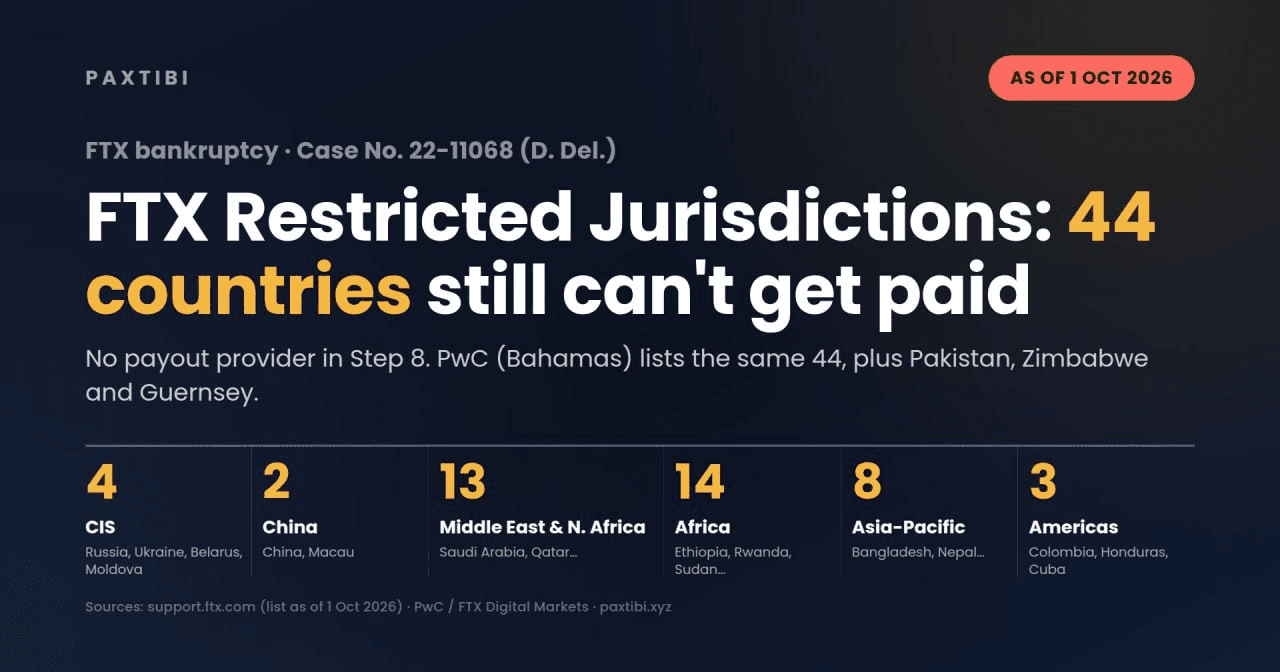
FTX's support page "General Information on Distribution Service Providers" lists 44 jurisdictions where, as of 1 October 2026, creditors cannot select a Distribution Service Provider (BitGo, Kraken or Payoneer). FTX says it is "continuing to assess eligible jurisdictions" and will update the portal "in due course". It has not given a date.
We have grouped the list by region, because the reasons and the practical options differ quite a lot between them.
| Region | Countries | Count |
|---|---|---|
| CIS and Eastern Europe | Russia, Ukraine, Belarus, Moldova | 4 |
| China | China, Macau | 2 |
| Middle East and North Africa | Saudi Arabia, Qatar, Kuwait, Egypt, Iraq, Lebanon, Syria, Iran, Morocco, Algeria, Tunisia, Libya, Western Sahara | 13 |
| Sub-Saharan Africa | Burundi, Cameroon, Central African Republic, Chad, Congo (Democratic Republic), Congo (Republic), Equatorial Guinea, Ethiopia, Gabon, Lesotho, Malawi, Rwanda, Somalia, Sudan | 14 |
| Asia and Pacific | Afghanistan, Bangladesh, Cambodia, Fiji, Maldives, Myanmar, Nepal, North Korea | 8 |
| Americas | Colombia, Honduras, Cuba | 3 |
| Total | 44 |
A few things that are not on the list, because we are asked about them every week: the United Arab Emirates, Kazakhstan, Hong Kong, Turkey, India and Pakistan are not restricted in the US process. Inside the United States, the limits are per provider rather than per country: BitGo does not serve New York, and Kraken does not serve New York, Washington or Maine.
Is the Bahamas (PwC) list different?
Only slightly. FTX Digital Markets, the Bahamian entity run by PwC as liquidator, publishes its own list of "potentially restricted foreign jurisdictions". It contains all 44 countries above, plus three more: Pakistan, Zimbabwe and Guernsey.
In practice this means that if you live in one of the 44 countries, switching processes would not have helped you. If you live in Pakistan or Zimbabwe, you can be paid in the US process but not, for now, in the Bahamas one. PwC says it cannot give "any details on timelines or likely outcomes at this stage".
| Process | Restricted jurisdictions | Count |
|---|---|---|
| US (FTX / Kroll) | The 44 jurisdictions listed above | 44 |
| Bahamas (PwC) | The same 44, plus Pakistan, Zimbabwe and Guernsey | 47 |
Why are these countries blocked?
FTX does not publish its reasons, so anything here is our reading rather than an official explanation. The list looks like a mix of two things. Some countries are under US or international sanctions (Iran, North Korea, Syria, Cuba, Russia, Belarus). Many others are simply places where none of the three providers is licensed or willing to pay out, or where local rules on crypto make it hard for them to do so. China, one of the largest groups of affected creditors by value, falls into the second category.
The distinction matters, because the second group can change quickly. A provider adds a licence or a new provider is signed, and a country comes off the list. Guernsey is not on FTX's October list. Sanctioned countries are unlikely to move.
What happens to your money if you do nothing?
This is where most creditors are given wrong or overly comforting information, including, until recently, on our own site.
Your distribution is deferred, not paid
FTX's own wording is that if a provider is unable to service your jurisdiction, "your distribution will be deferred to a later date". Your claim remains allowed, and the money for it stays inside the estate. You are not paid in the current round.
The six-month forfeiture rule
Separately, FTX's Distributions Dashboard FAQ says that a holder who does not onboard with a provider (Step 8) within six months of the distribution date "may forfeit their right to receive distributions" on that claim. For the 31 July 2026 round, six months is about 31 January 2027. For the tax form (Step 7), the deadline is 90 days from FTX's first notice after each record date.
FTX has not said how this rule applies to someone who cannot onboard at all because their country is blocked. We would not assume that the deferral protects you indefinitely. Our view is simple: if you have a restricted claim of any meaningful size, January 2027 is the date to plan around.
The court route was tried and withdrawn
In July 2025 the FTX Recovery Trust filed a motion asking the court to approve special procedures for claims in "potentially restricted foreign jurisdictions" (D.I. 31148). Creditors from several of the affected countries objected. On 3 November 2025 the Trust withdrew the motion (D.I. 33439), and nothing has replaced it since. So there is currently no court-approved procedure that would either pay these claims or cancel them. The status quo is the support-page list and the forfeiture rules above.
Your options if your country is on the list
1. Wait and watch the list
Free, and reasonable if your claim is small or you believe your country is close to being added. Check Step 8 in the portal and the FTX support page every month. Keep KYC and the tax form complete, so you can onboard the day your country is opened. The cost is time, and the January 2027 risk above.
2. Update your residence, if you have genuinely moved
If you actually live in another country now, you can ask FTX to update your jurisdiction. The process: email KYC-Support@ftx.com from the address registered on your FTX account, provide the documents they ask for (proof of residence), submit a new W-8 or W-9 in Step 7, then select a provider. The provider country must match your KYC country. This only works if the move is real. A temporary address or a friend's address abroad will not pass the provider's own checks, and it can freeze the claim.
3. Sell the claim
A claim from a restricted country can be sold to a buyer who is in an eligible jurisdiction. The buyer files the transfer with the court. After the 21-day notice period passes without objection, the buyer becomes the holder of record and receives future distributions. You get paid now, in a currency and to an account you choose, at a discount to the claim's remaining value. The discount is the buyer's price for the wait and the risk. Ask any buyer to explain exactly how they handle the transfer and what happens if the court process is delayed. A serious buyer will put it in writing.
4. Payment processing instead of a sale
For larger claims, there is a middle route. The claim is transferred to an intermediary in an eligible jurisdiction, which receives the distributions and passes them on to you, net of an agreed fee. You keep the upside of future rounds instead of taking a discount today. Paxtibi offers this service, so read this as a description from an interested party. The details are on our payment processing page.
What we would not do
Do not pay anyone who promises to "get your country unblocked". Do not share your portal login or seed phrases. Do not pay upfront fees. FTX itself warns that it will never ask you to connect a wallet. Restricted-country creditors are a favourite target for scams precisely because they have no official route.
Region by region: what is specific
Russia, Ukraine, Belarus and Moldova
All four are restricted in both processes. Russia and Belarus are sanctions cases and unlikely to change soon. Ukraine and Moldova are not sanctioned, and their inclusion has drawn the most objections from creditors. A creditor in Ukraine with a large claim should not wait for a change before January 2027 without a plan B. Kazakhstan, Georgia, Armenia and the other CIS countries are not on the list.
China and Macau
China is one of the largest restricted groups by claim value, and the hardest to change, because of local rules on crypto rather than sanctions. Hong Kong is not restricted. If you are a mainland resident who has genuinely moved to Hong Kong, option 2 applies.
Middle East and North Africa
Thirteen countries, including Saudi Arabia, Qatar, Kuwait and Egypt, which are not sanctioned and have large creditor numbers. The UAE, Bahrain, Oman and Jordan are not on the list. Many Gulf creditors are expatriates; your KYC country, not your passport, is what counts.
Sub-Saharan Africa, Asia and the Americas
Fourteen African countries, eight in Asia and the Pacific, and Colombia, Honduras and Cuba in the Americas. Claims here are usually smaller, so option 1 or a sale is more common than processing. Note that Payoneer, the provider most often used in these regions, only pays individual distributions above $50.
Our take
The list has moved only at the margins in a year, and the court route is off the table for now. For a restricted creditor, the honest answer is that nothing is likely to change before the six-month mark in January 2027. If the claim is small, keep your KYC and tax form done and wait. If it is large, compare the cost of a sale or processing with the risk of losing a distribution, and decide before the deadline rather than after it.
Related FTX guides
FAQ
Which countries cannot receive FTX distributions?
As of 1 October 2026, residents of 44 jurisdictions cannot select a distribution provider in the FTX Customer Portal, including Russia, Ukraine, Belarus, China, Saudi Arabia, Egypt, Qatar, Kuwait, Morocco and Colombia. FTX says the list may change as it assesses eligible jurisdictions.
Is the PwC (Bahamas) restricted list the same as FTX's?
Almost. PwC's list for FTX Digital Markets includes all 44 countries on FTX's list plus Pakistan, Zimbabwe and Guernsey.
What happens to my FTX distribution if my country is restricted?
FTX says the distribution is deferred to a later date. Separately, its FAQ warns that a holder who does not onboard with a provider within six months of the distribution date may forfeit that distribution, which for the 31 July 2026 round is about 31 January 2027.
Can I change my country to receive an FTX payout?
Only if you have genuinely moved. Email KYC-Support@ftx.com from your registered address, provide proof of residence, submit a new tax form in Step 7 and then select a provider in your new country.
Can I sell an FTX claim from a restricted country?
Yes. A buyer in an eligible jurisdiction can take the transfer and receives future distributions once the 21-day notice period has passed without objection.
Sources
- FTX: General Information on Distribution Service Providers (1 October 2026)
- FTX: Distributions Dashboard FAQs
- FTX: Selecting a Distribution Service Provider
- PwC: Potentially Restricted Foreign Jurisdictions
- Motion to implement restricted jurisdiction procedures (D.I. 31148, 2 July 2025)
- Notice of withdrawal (D.I. 33439, 3 November 2025)
- FTX: fifth distribution release (17 July 2026)
Disclaimer: this article is for information only and is not legal, tax or financial advice. Paxtibi buys bankruptcy claims and offers payment processing, so we have a commercial interest in this topic.