
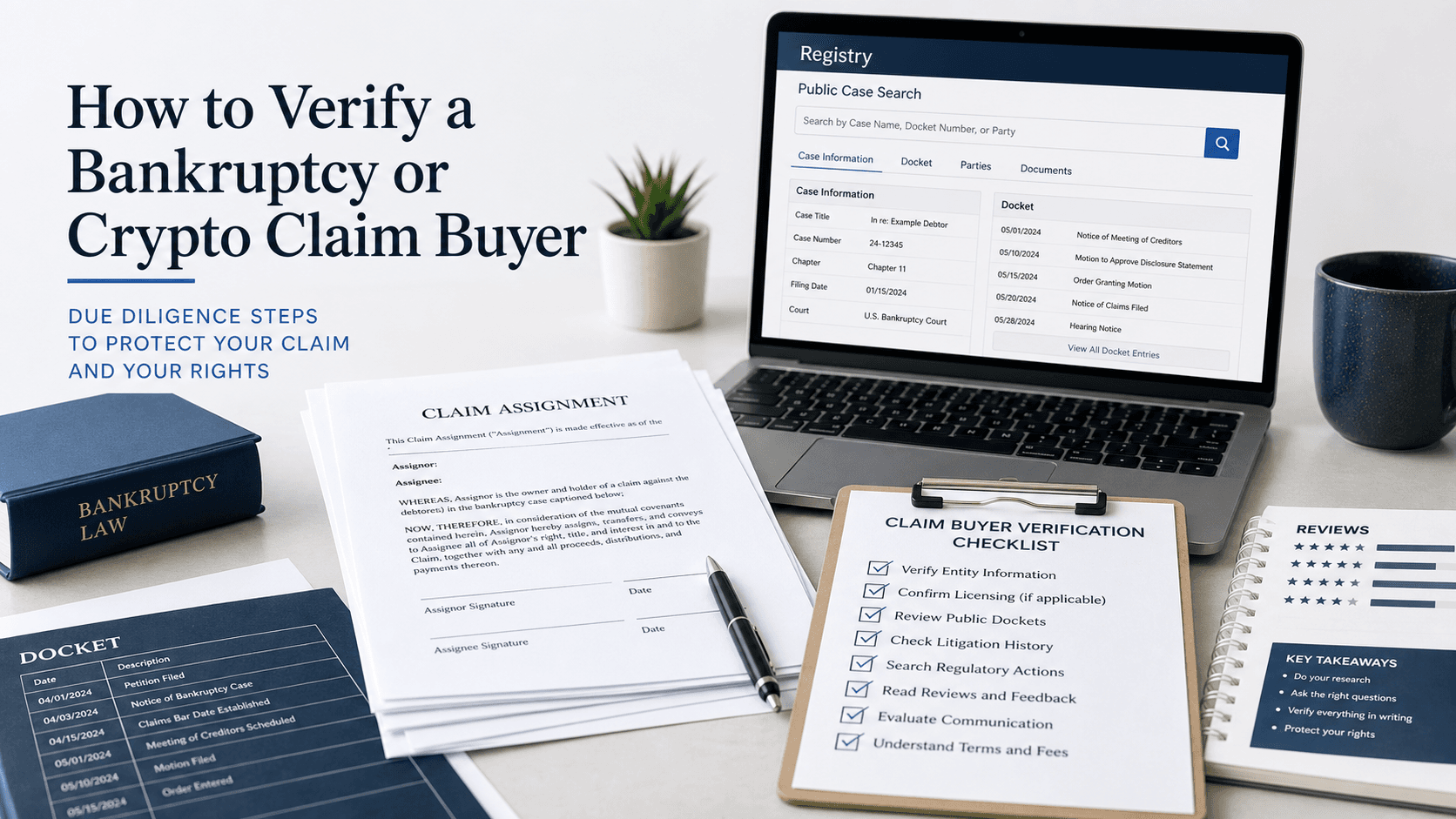
You can verify almost any FTX or crypto claim buyer in about twenty minutes, using three free checks: a public company registry, independent reviews the company doesn't control, and the court's own claims docket. If the buyer cannot be found in those places, asks you to pay money, or wants wallet keys or remote access, stop before signing.
Last updated:
Selling a bankruptcy claim is the sale of a financial asset. It deserves the same caution you would apply to any other transaction involving real money, especially because buying claims is not a licensed activity.
There is no official register of approved claim buyers. There is, however, a public record of many claim transfers. In large bankruptcies, transfers are filed with the court and published.
Add a public company registry to that, and most claim buyers can be checked in about twenty minutes.
What are the two main risks when selling a bankruptcy claim?
Most warnings about claim-buying scams combine two separate problems. They need separate defenses.
Risk 1: the counterparty is not a claim buyer at all. This is a standard crypto scam aimed at your device, wallet, or credentials.
Risk 2: the counterparty is real, but the deal is bad or payment does not arrive. The claim is assigned, but the seller never receives the agreed funds.
How do fake claim buyers use impersonation and poisoned links?
The most common technical attack is a fake meeting link. You are invited to Zoom, Google Meet, or Microsoft Teams, but the link downloads software that searches for wallet keys or seed phrases.
- Find the company independently and use contact details from its official website.
- Confirm the domain matches exactly; impersonators use lookalike domains.
- Treat unsolicited attachments, installers, or verification tools as hostile.
- Never share a seed phrase, private key, or wallet password. A claim sale is a court-recorded assignment, not a wallet transaction.
Is it safe to work with agents or intermediaries?
Many real buyers work with agents, and an introduced deal can be legitimate.
The rule is simple: KYC, the signed agreement, and the payment should run through the buying entity directly.
If someone claims to represent a firm, email that firm through the address on its official site and ask for written confirmation.
What should I check before selling my claim to a buyer?
| Check | What you are looking for | Where |
|---|---|---|
| Company registration | An active legal entity with filings up to date | Public company registry |
| Named people | Real founders and staff you can cross-check | Registry filings and LinkedIn |
| Independent reviews | Reviews on platforms the company does not control | Trustpilot or Google |
| Court docket history | Prior claim transfers filed with the court | Kroll for FTX, Epiq for Terraform |
| Pricing methodology | A written explanation of how the price was reached | The offer itself |
| Formal agreement | A proper claim assignment agreement before anything moves | The contract |
| Zero cost to you | No fees requested from the seller | Any payment request is a red flag |
How can I check whether the buyer company really exists?
Not every jurisdiction publishes company data. That is exactly why some firms incorporate where nobody can look.
A public registry lets you confirm that the entity exists, that its status is active, that filings are current, and who the people behind it are. The UK's Companies House is a useful example because all of that is free and public.
Once you have the names, cross-check them against LinkedIn, press coverage, and industry sources.
Where can I find reviews the buyer does not control?
Testimonials on a company's own website are marketing. Reviews on Trustpilot or Google are harder for the company to control.
Read the substance, not only the score. Reviews that describe the actual sequence of quote, KYC, contract, and payment are the useful ones.
How can I use the court docket to verify a claim buyer?
Bankruptcy proceedings are public. When a claim is sold, the buyer files a notice of transfer with the court. The court records it, the claims register is updated, and the buyer receives future distributions.
If a buyer has actually purchased a claim in that case, their name should appear on the docket. If it does not, you may be their first seller, and you should ask why.
FTX Trading Ltd., Case No. 22-11068, administered by Kroll. Kroll docket. Use the Docket tab and search the buyer company name. Do not use the Claims tab; it searches individual creditor claims and will not show transfers.
Terraform Labs, administered by Epiq. Epiq docket. Use the same approach: open the docket and search the buyer name.
Why does claim transferability matter?
A claims market exists because reassignment is a formal, court-supervised procedure. Not every insolvency permits it.
FTX Europe claims were never tradable because that proceeding did not allow buyers to take assignment of a claim. Anything that happens off the docket is not a claim sale.
Should a seller ever pay anything to sell a claim?
In a claim sale, you are the seller. The buyer pays you. There is no legitimate reason for money to move the other way.
Never pay a processing fee, consultation fee, escrow deposit, release payment, legal cost, tax, or transfer charge in advance. Any request for payment from you should end the conversation.
What are the red flags of a fake claim buyer?
| Red flag | Why it matters |
|---|---|
| A price far above the market | If the price cannot be explained by a stated methodology, it is bait. |
| Any upfront payment | This is the clearest fraud signal in the market. |
| Urgency and pressure | Pressure exists to stop you from doing the checks in this article. |
| No written contract | Without a documented assignment, you transfer a legal right on a promise. |
| Requests for keys, seeds, or remote access | No part of a claim sale requires them. |
| An intermediary who will not let you reach the buyer | This points to either a hidden commission or impersonation. |
| No registry record, no docket history, no named people | Nothing to verify means nothing to hold accountable. |
If the price of the product is zero, you are the product. When someone offers terms that make no commercial sense, work out what they are actually collecting.
Take your time. Reviewing documents, verifying the entity, and sending one confirmation email can be the cheapest insurance available.
How does Paxtibi meet these verification tests?
We wrote this guide with the checks applied to ourselves, because a buyer that asks for trust should be easy to verify.
- Public registration. Paxtibi LLP is registered in the United Kingdom, Companies House No. OC449662.
- Named founders. Alberto Visona and Federico Natali are publicly identifiable and reachable.
- Independent reviews. Paxtibi has independent reviews on Trustpilot and Google, not only testimonials on our own site.
- Docket history. Our FTX claim transfers are filed and publicly recorded in the FTX proceeding.
- Written pricing methodology. Every offer explains how the price was reached.
- Formal assignment agreement. Nothing moves before the assignment documents are signed.
- No fees. We buy with our own capital and never ask sellers for upfront payment or any cost.
If someone contacts you claiming to represent Paxtibi, email the address on this site. If they are one of our agents, we will confirm it in writing.
What questions should I ask before trusting a claim buyer?
Is there an official register of approved claim buyers?
No. Buying claims is not a licensed activity. What is public is the record of claims traded through court-filed transfer notices.
Can I check whether a buyer has really bought claims before?
Yes. Search the buyer company name on the relevant court docket, such as Kroll for FTX or Epiq for Terraform.
Should a claim buyer ever ask me to pay something?
No. The seller has no costs in a normal claim sale. Upfront fees, processing charges, or deposits should be treated as fraud.
Is it safe to deal through an agent or broker?
It can be, as long as KYC, the signed agreement, and payment go through the buying entity directly.
Do I need to give a claim buyer my wallet keys?
Never. A claim sale is a legal assignment recorded with the court. It requires identity documents and a signature, not private keys or seed phrases.
Considering a sale? Sell your FTX claim / Sell your Terra Luna claim