
The case in one paragraph
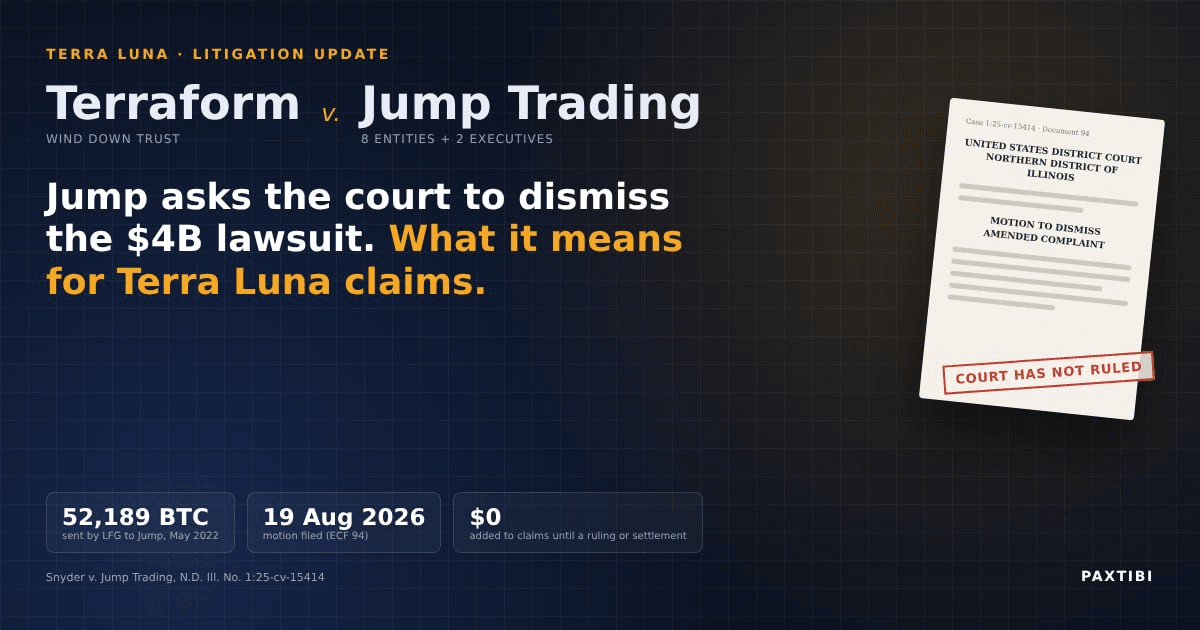
The plaintiff is Todd Snyder, who administers what is left of Terraform Labs after its bankruptcy, acting for the estate and for the Wind Down Trust. Terra Luna creditors with Crypto Loss Claims assigned their own claims against third parties to that trust, so the trust sues partly on their behalf. The defendants are eight Jump entities, including Jump Trading LLC, Jump Crypto Holdings and Tai Mo Shan Limited, former Jump Crypto president Kanav Kariya and Jump co-founder William DiSomma. The case is Snyder v. Jump Trading, LLC, No. 1:25-cv-15414, before District Judge Joan H. Lefkow in the Northern District of Illinois.
The core allegations, as reported when the suit was filed: Jump had undisclosed deals with Terraform going back to 2019, secretly bought UST to restore its peg in May 2021 while the recovery was presented as proof the algorithm worked, then sold discounted LUNA for large profits. The trust alleges that, in May 2022, the Luna Foundation Guard (LFG) sent Jump 52,189 bitcoin, worth about $1.5 billion, to defend the peg. It says those transfers should be clawed back. These are allegations, not findings against Jump.
How we got here
| Date | Event |
|---|---|
| 2019 | The alleged undisclosed arrangements between Jump and Terraform began, according to the complaint. |
| May 2021 | The complaint alleges that Jump bought UST to restore its peg while the recovery was presented as proof that the algorithm worked. |
| May 2022 | The trust alleges that LFG transferred 52,189 BTC to Jump to defend the peg. Those transfers are central to the clawback dispute. |
| 21 January 2024 | Terraform filed for Chapter 11 in Delaware. |
| 2024 | A jury found Terraform and Do Kwon liable in the SEC case; Terraform settled for about $4.5 billion. |
| December 2025 | Do Kwon was sentenced to 15 years; the trust sued Jump seven days later. |
| 18 December 2025 | Todd Snyder filed the original lawsuit in federal court in Chicago. Press reports put the amount sought at about $4 billion. |
| 1 May 2026 | The trust filed the amended complaint after Jump's first motion to dismiss. |
| 19 August 2026 | Jump filed its 85-page motion to dismiss the amended complaint with prejudice, ECF 94. |
What Jump argues
Jump's motion runs to 85 pages and attacks all 13 claims. Its main arguments concern how the complaint identifies the defendants, the filing deadlines, the reach of US law and ownership of the bitcoin transferred by LFG.
“Jump” is not a defendant
The complaint calls eight separate companies “Jump” throughout. Jump argues that fraud claims must say who did what, when and how, for each defendant, and that lumping the entities together is grounds for dismissal. The issue is whether the complaint identifies each defendant’s alleged conduct with sufficient specificity.
Too late
Jump says the securities fraud claims have a two-year limit and that the clock started no later than 17 June 2022, when a class action, Patterson v. Terraform Labs, made the same accusations against Jump in public. The December 2025 filing came about three and a half years after that date: on Jump's calculation, roughly a year and a half beyond the asserted two-year deadline. Jump also argues that the Illinois consumer fraud claim falls outside its three-year limit. The court must decide whether those arguments apply.
Wrong country
Jump argues that the securities claims require domestic transactions and that the complaint does not identify where Terra creditors bought UST or LUNA. On that basis, it says the complaint has not established that the purchases fall within US securities law. It raises related territorial objections to the Illinois statutory claims and the bankruptcy clawback claims.
Terraform cannot pass its SEC bill to Jump
One claim asks Jump to contribute to Terraform's $4.5 billion SEC judgment. Jump argues that no court has recognised a right to contribution for an SEC penalty. It also argues that Terraform, found liable for fraud by a jury, cannot recover from others for a fraud it took part in. These are Jump's grounds for opposing the contribution claim, not a ruling on it.
UST and LUNA were not securities, as pleaded
Jump argues that the complaint does not show that each creditor's purchase was an investment contract. It relies on the distinction drawn in the SEC case between UST on its own and investment arrangements involving it. The motion asks the court to apply that distinction to the claims pleaded here.
The bitcoin was LFG’s, not Terraform’s
This matters most for the clawback. The trust's new theory is that LFG was Terraform's alter ego, so LFG's bitcoin was really Terraform's property and its transfer to Jump can be undone. Jump responds with three arguments:
- Jump says Terraform argued during the bankruptcy that LFG was a separate entity and cannot now take the opposite position.
- Jump argues that LFG is a Singapore entity and that Singapore law sets a high bar for treating it as Terraform's alter ego.
- Jump says Terraform received value for the transfer. According to the motion, Jump returned about 1.52 billion UST and 5,313 BTC, worth $1.37 billion, and acted in good faith.
Jump also argues that individual creditors never had bankruptcy clawback claims of their own to assign to the trust, because those claims belong to the bankruptcy estate.
How strong is the motion?
A motion to dismiss generally tests whether the pleaded allegations, accepted as true for that purpose, state a legally sufficient claim. It is not a trial of the competing evidence. The court can dismiss all or some claims, allow claims to proceed, or permit further amendment where appropriate. Jump is asking for dismissal with prejudice, which would end the dismissed claims in this action rather than allow another amended pleading.
The limitations and contribution arguments focus on dates and legal rules. The clawback dispute also raises questions about the relationship between LFG and Terraform and the value received for the transfers. Those differences help explain the motion, but do not establish which claims will survive. The bitcoin transfer is a concrete amount in dispute, not an assured recovery.
This is our reading of the arguments described here, not a prediction of the ruling.
What it means for Terra Luna claim holders
The lawsuit does not itself change the size of your Allowed Crypto Loss Claim. It can affect how much cash the Wind Down Trust ultimately has available to distribute.
The trust's identifiable assets are modest against roughly $4.47 billion of investor losses. No recovery percentage has been announced, and the trust's report for the quarter ending 31 March 2026 recorded no distributions. Paxtibi's current estimate is a mid single-digit overall recovery, including possible litigation proceeds. It is an estimate, not an announced distribution or an amount supported solely by cash already held.
A judgment or settlement would have to produce money that the trust can collect, with legal costs reducing the amount available to creditors. Further proceedings and any appeal could take years. The amount sought in the complaint should not be treated as cash available for distribution.
For the wider recovery picture, see our Terra Luna payment update and guide to Terra/Luna Crypto Loss Claims.
What happens next
- The briefing sequence is the trust's response followed by Jump's reply. The procedural status described here is as of 19 October 2026; the August motion is not a new filing this week.
- The judge decides whether to dismiss all claims, dismiss some claims or deny the motion. Any permission to amend will depend on the order.
- If claims survive, the case can proceed to evidence gathering and further litigation. A settlement is possible, but neither its timing nor its terms can be assumed.
We will update this article to cover the response, reply or ruling as further developments are incorporated.
Our take
Jump's motion challenges both the legal basis of the claims and the way they are pleaded. Timing and contribution could be consequential issues; the bitcoin clawback also depends on disputed questions about LFG and the transfers. For a Terra Luna creditor, potential litigation proceeds remain uncertain and may take years to realise, if they are recovered at all. If you would rather not wait, compare a buyer's offer today with your own expectations for future distributions, and ask how the price treats the Jump case.
Discuss selling a Terra Luna claim
Frequently asked questions
What is the Terraform lawsuit against Jump Trading about?
Terraform's Plan Administrator, acting for the estate and the Wind Down Trust, alleges that Jump secretly propped up UST, profited from discounted LUNA and received about 52,189 bitcoin from the Luna Foundation Guard in May 2022. The suit, filed in December 2025 in the Northern District of Illinois, seeks about $4 billion according to press reports.
What did Jump Trading argue in its motion to dismiss?
In its 19 August 2026 motion, Jump argues that the complaint lumps eight companies together, that the securities claims are time-barred, that the transactions are outside US and Illinois law, that Terraform cannot recover its SEC penalty from Jump, and that the bitcoin transferred belonged to LFG, not Terraform.
Has the court ruled on Jump's motion?
As of 19 October 2026, no ruling is reflected in the materials covered here. The briefing sequence is the plaintiff’s response followed by Jump’s reply. Judge Joan H. Lefkow then decides whether to dismiss all, some or none of the claims.
Will the Jump lawsuit increase Terra Luna claim recoveries?
Possibly, if a judgment or settlement produces funds that can be collected, after legal costs and potentially years of litigation. Paxtibi's mid single-digit overall recovery estimate includes possible litigation proceeds; it is not an announced recovery percentage or a cash-only estimate.
Does the lawsuit change the size of my Crypto Loss Claim?
No. Your allowed Crypto Loss Amount stays the same. The lawsuit can affect only how much cash the Wind Down Trust has to distribute to all claim holders.
Sources
- Jump Defendants' Motion to Dismiss Amended Complaint, Snyder v. Jump Trading, LLC, No. 1:25-cv-15414 (N.D. Ill.), ECF 94, filed 19 August 2026.
- Snyder v. Jump Trading, LLC docket, No. 1:25-cv-15414 (N.D. Ill.), Justia Dockets.
- Original complaint, filed 18 December 2025 (Wolters Kluwer copy).
- Decrypt: Terraform Bankruptcy Admin Sues Jump Trading for $4B Over TerraUSD Collapse, 19 December 2025.
- DL News: Jump Trading slams $4bn Terraform lawsuit as attempt to “pass the buck”, 24 March 2026.
- SEC, In the Matter of Tai Mo Shan Limited, Release No. 11349 (20 December 2024).
Disclaimer: this article is for information only and is not legal, tax or financial advice. Paxtibi buys bankruptcy claims and offers payment processing, so we have a commercial interest in this topic. The motion described here is one party's argument, not the court's decision.