
What the case is about
In 2019 Binance bought about 20% of FTX Trading for $18.3 million. Binance’s founder and two of its executives held another 18.4% of West Realm Shires, the parent of FTX US. In July 2021 FTX bought these stakes back.
Alameda Research paid for the buyback through a newly created subsidiary. The payment was crypto worth about $1.76 billion:
- FTX’s own token, FTT;
- Binance’s token, BNB;
- Binance’s stablecoin, BUSD. About $721 million in US dollars was sent to mint it.
The estate says bankruptcy law lets it undo (“claw back”) that payment for two reasons:
- FTX’s founder made it with intent to defraud creditors;
- FTX and Alameda were already insolvent and got shares the complaint calls worthless.
Binance disputes this and argues that FTX paid market value. The court said that is a question of fact for later.
The estate also claimed damages over Binance’s public statements during FTX’s collapse in November 2022.
What the court decided on 24 July 2026
| Question | Decision |
|---|---|
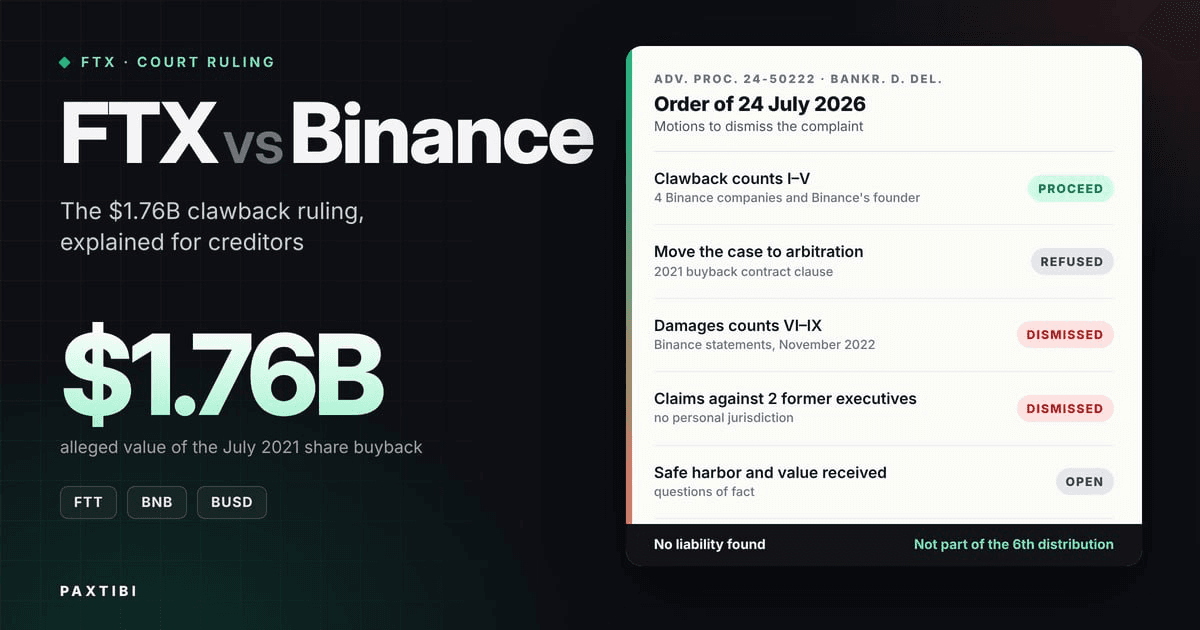
| Fraudulent-transfer counts I–V against four Binance companies and Binance’s founder | Go ahead |
| The same counts against two former Binance executives | Dismissed: the court found it had no jurisdiction over them |
| Damages counts VI–IX over Binance’s November 2022 statements | Dismissed |
| Sending the dispute to arbitration | Refused |
| The court’s jurisdiction over the case and over Binance’s founder | Confirmed at this stage |
| Safe harbor for securities transactions (§ 546(e)) | Not decided: a question of fact |
| Where the transfer took place | Treated as a US transfer “for this stage” |
| Whether FTX got fair value for the payment | Not decided: a question of fact |
Four points in plain words:
- Why the damages claims failed. The court applied a rule called in pari delicto (“in equal fault”): a company cannot sue an outsider for harm that grew out of its own insiders’ fraud. The court treated the fraud of FTX’s insiders as FTX’s own.
- The clawback claims are different. Bankruptcy law lets the estate undo transfers for the benefit of creditors, so these claims survived.
- Why no arbitration. The 2021 buyback contract had an arbitration clause. The court held that the clawback claims come from bankruptcy law, not from the contract, so the clause does not cover them.
- What “go ahead” means. At this stage the court assumes the complaint’s facts are true. It only asks whether the claims could succeed in law. Binance can still contest every fact.
What it means for creditors
- It is not money now. A recovery needs a judgment or a settlement, and then collection. Our estimate, not a court date: that is likely years away.
- Settlement can come at any time. FTX’s $1.15 billion suit against Genesis Digital Assets was dropped with prejudice nine months after it was filed, and the terms were never disclosed.
- $1.76 billion is a claim, not a forecast. It is the alleged value of the 2021 payment. What the estate might recover depends on the outcome. For scale, FTX has already paid out more than $11 billion.
- Any money goes to the Trust. It would be paid out under the plan to holders on the claims register at a later record date. Recoveries still matter: the Trust’s Q2 2026 report shows about $2.4 billion of accrued interest unpaid as of 31 July 2026, before that day’s distribution.
- No effect on the next payout. The 6th distribution has not been announced. Our estimate, not FTX’s, is a record date around mid-December 2026 and a payment around late January 2027. The Binance case will not change it.
Selling or holding.
- If you sell your claim, any future Binance recovery goes to the buyer.
- If you hold, you keep that possibility, but on the court’s timeline.
- Either way, it is not money to plan around yet (how to sell an FTX claim).
What’s next (updated 2 November 2026)
- Binance’s response and the schedule. The four Binance companies and Binance’s founder now respond to the surviving counts. Then comes discovery: the exchange of documents and testimony. As of 2 November 2026 we have found no public report of a trial schedule or a settlement.
- A possible appeal on arbitration. The law allows an immediate appeal against an order refusing arbitration. We have found no report of one.
The open questions will be decided on evidence:
- the safe harbor;
- where the transfer took place;
- which law applies;
- the value FTX received.
The Trust’s Q3 2026 report. We expect it around mid-November; that is our expectation, not a filing date. It may describe the state of the litigation.
We will update this section after each court event.
Our take
The ruling keeps one of the estate’s larger claims alive and closes the easy exits for Binance: no arbitration, no dismissal on jurisdiction. It also narrows the case to the 2021 payment. For creditors, treat it as a long-dated possibility, not as money on the way.
FAQ
Why did FTX sue Binance and CZ?
To recover about $1.76 billion in crypto that Alameda Research paid in July 2021 to buy back the stakes Binance, CZ and two executives held in FTX. The estate argues that bankruptcy law lets it undo the payment: Sam Bankman-Fried made it to defraud creditors, and FTX and Alameda were already insolvent. The suit also sought damages over CZ’s posts during FTX’s collapse in November 2022, but the court dismissed those claims.
Did FTX win its lawsuit against Binance?
No. On 24 July 2026 the court only ruled that the clawback claims can go ahead against four Binance companies and Binance’s founder. No liability has been found, and Binance can still contest every fact.
How much is FTX trying to recover from Binance?
About $1.76 billion, the alleged value of the FTT, BNB and BUSD that Alameda paid in July 2021 to buy back Binance’s stake in FTX. What the estate actually recovers depends on a judgment or a settlement.
Who is the judge in FTX v. Binance?
US Bankruptcy Judge Karen B. Owens of the US Bankruptcy Court for the District of Delaware. The case (Adv. Proc. 24-50222) is part of FTX’s Chapter 11 case, No. 22-11068. She issued the ruling of 24 July 2026.
What happened to the claims over CZ’s November 2022 tweets?
The court dismissed them. The estate sought damages over public statements by Binance and CZ during FTX’s collapse, including CZ’s post of 6 November 2022 that Binance would sell its FTT. The court applied in pari delicto (“in equal fault”): a company cannot sue an outsider for harm that grew out of its own insiders’ fraud. Only the clawback claims over the 2021 payment survive.
Can Binance appeal the ruling?
The order refusing arbitration can be appealed right away; the Federal Arbitration Act allows that. The rest of the ruling can generally be appealed only after a final judgment, unless a court gives permission earlier. An appeal on arbitration could delay the case. As of 2 November 2026, we have found no public report of an appeal.
Will the Binance case increase the 6th FTX distribution?
No. The case is at an early stage, and any money would come only after a judgment or a settlement. The 6th distribution has not been announced (as of 2 November 2026).
Does CZ’s 2025 pardon end the FTX lawsuit?
No. A presidential pardon covers federal crimes. This is a civil bankruptcy case, and on 24 July 2026 the court let the clawback claims against CZ proceed.
If I sell my FTX claim, who gets any Binance recovery?
The buyer. A full transfer of a claim, filed under Bankruptcy Rule 3001(e), moves the right to all future distributions on it, unless the sale agreement says otherwise.
Sources
- US Bankruptcy Court for the District of Delaware, Opinion and Order Regarding Defendants’ Motions to Dismiss the Complaint, FTX Recovery Trust v. Binance Holdings Ltd. et al., Adv. Pro. No. 24-50222, 24 July 2026.
- FTX Recovery Trust, Q2 2026 financial report (D.I. 36154, filed 17 August 2026).
- Bloomberg Law, “FTX Trust Gets a Shot to Pursue Binance, Ex-CEO for $1.8 Billion”, 27 July 2026.
- CryptoSlate, “Judge lets FTX recovery trust chase Binance for $1.76 billion over a 2021 share buyback”, 31 July 2026.
- Okin Adams, “Case Alert: FTX–Binance Ruling Preserves $1.76 Billion Clawback Claims”, 31 July 2026.
- The Block, “Binance asks court to toss FTX’s $1.76 billion clawback lawsuit”, 20 May 2025.
- Bloomberg Law, report on the presidential pardon of Binance’s founder, 23 October 2025.
Disclaimer: this article is for information only and is not legal, tax or financial advice. Paxtibi buys bankruptcy claims and offers payment processing, so we have a commercial interest in this topic.