
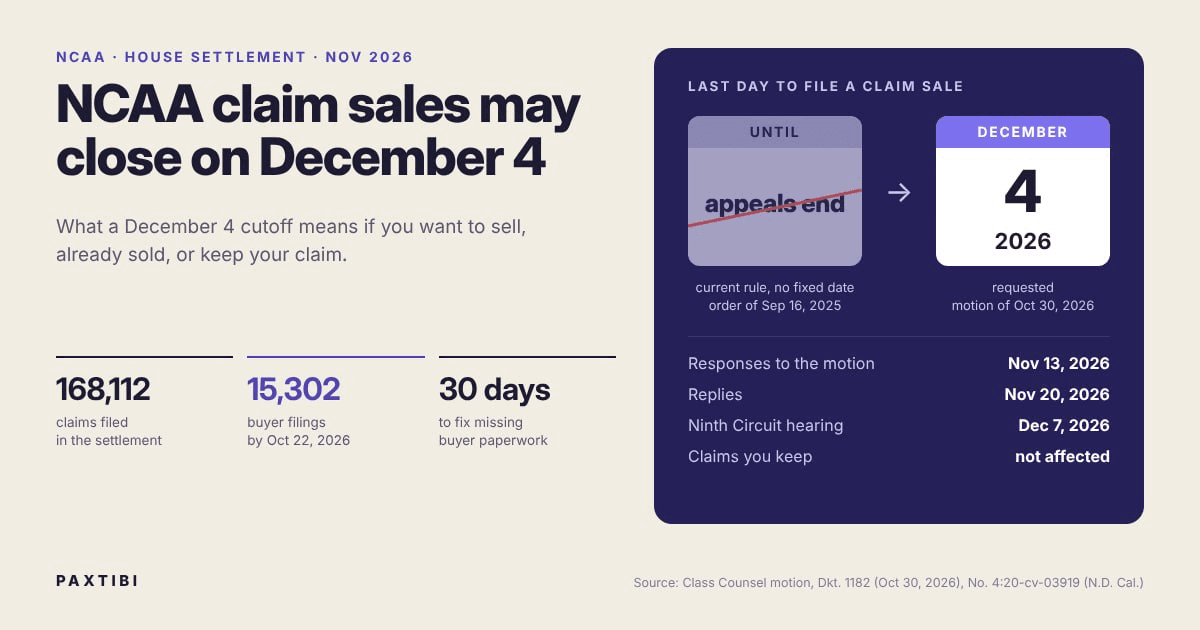
What did Class Counsel ask the court for?
Three things, in one motion filed on October 30, 2026:
- A deadline. Buyers would have until December 4, 2026 to file the paperwork that lets the administrator pay them instead of the athlete.
- A review plan. The rules the administrator would use to accept, fix or reject buyers’ filings, including cases where two buyers claim the same claim (see the table below).
- Paying the administrator from interest. Administration had cost $2,732,471.04 by September 30, 2026, against $3 million set aside in the settlements, and Class Counsel expects to go over. It asks to pay the costs from the interest earned on the money in escrow, so nothing comes out of athletes’ estimated payments.
The court has not ruled. Under the docket schedule, responses are due November 13 and replies November 20, 2026. No hearing date is set, so the court may decide on the papers. If it agrees, the deadline will be posted on the settlement website.
Why December 4?
- The 2025 rule. Since September 16, 2025, the settlement fund pays a buyer directly only if the athlete sold the claim outright and the sale was completed before the appeals are over. That end point has no date.
- The appeal hearing. The Ninth Circuit hears the appeals of the settlement on December 7, 2026. December 4 is the last business day before it. After the hearing, a decision could come at any time.
- One review instead of many. With a fixed date, the administrator can review all buyers’ filings once, rather than again and again until the appeals end.
- Taxes. The 2025 rule is there to protect athletes from tax problems; it relies on an IRS ruling about selling a claim while appeals are pending.
- Enough time, Class Counsel says. Athletes and buyers both benefit from a fixed date, and athletes who wanted to sell have had plenty of time, given the notice campaign and the long appeal.
| Date | What happened | Source |
|---|---|---|
| June 6, 2025 | The court approves the House settlement | Dkt. 979 |
| September 16, 2025 | Order on claim buyers: tax warning, outright sales only, notice within 15 days | Dkt. 1047 |
| October 1, 2025 | Last day to file a claim | Dkt. 1022 |
| October 10, 2025 | Verita opens a portal for buyers’ filings | Dkt. 1182-1 |
| October 2 and 23, 2026 | Notices about missing information on about 10,000 claims | Dkt. 1182 |
| October 30, 2026 | Class Counsel asks for a December 4 deadline | Dkt. 1182 |
| November 13, 2026 | Responses to the motion due | Docket |
| November 20, 2026 | Replies due | Docket |
| December 4, 2026 | Requested last day for buyers’ filings | Dkt. 1182-2 |
| December 7, 2026 | The Ninth Circuit hears the appeals | Dkt. 1182 |
What the deadline means for you
The proposed cutoff and review plan below would apply if the court approves them. They are not a new order yet.
| Your situation | What changes | What to do |
|---|---|---|
| You filed a claim and will keep it | Nothing. Payments still wait for the appeals | Answer any notice from Verita. See when payments may start |
| You want to sell | Under the proposal, the sale must close and the buyer must file it with Verita by December 4 | Start now. Paxtibi takes new claims until November 30, 2026, subject to state restrictions |
| You already sold | Verita would check your buyer’s filing. Missing papers get a notice and 30 days to fix | If your buyer asks for a W-9, a photo ID or a signature, send it quickly |
| Your buyer’s filing is denied | Verita pays you at distribution, if your claim is valid | Your contract with the buyer still applies; read it, or ask a lawyer |
| You signed with two buyers | No payment until the buyers agree in writing or a court decides who owns the claim | Tell both buyers and get legal advice |
| You took a loan or an advance on your claim | Verita will not pay that company; it pays you | You may still owe the company under your contract |
| Someone offers to buy after December 4 | If the court agrees, the fund will not pay that buyer | Treat such an offer with caution |
How Verita would review the sales
Buyers have been busy: two of them say they have bought about $700 million of claims. By October 22, Verita had spent about 1,800 hours on a first review of buyers’ filings. A filing is not approved just because it was received.
| Problem in the buyer’s filing | What happens under the proposed plan |
|---|---|
| Bill of sale missing or unsigned, or unclear whether it is an outright sale | Notice, 30 days to fix |
| A W-9 (the buyer’s or yours) missing, unsigned, or with an invalid tax ID | Notice, 30 days to fix |
| No government photo ID for you | Notice, 30 days to fix |
| The buyer’s tax indemnification missing or unsigned | Notice, 30 days to fix |
| The deal is a loan or an advance, not an outright sale | Denied |
| No signed tax warning for a sale made after September 16, 2025 | Denied; a late warning does not fix it |
| A problem not fixed within 30 days | Denied |
| Two or more buyers filed for the same claim | No payment until the buyers sign an agreement or show a court ruling on ownership; payment goes to one only |
- Under the proposal, sales made before September 16, 2025 are accepted without the tax warning, because the rule did not exist yet.
- If a filing is denied, Verita pays you instead. It cannot decide whether you owe the money to the buyer, so your contract may still require you to pass on each payment, with possible tax consequences, for the ten years of the settlement.
What a buyer has to file, and what it needs from you
Verita’s portal for buyers has been open since October 10, 2025 and takes one filing per claim. It asks for:
- A W-9 for the buyer.
- A W-9 for you.
- Your government photo ID.
- A signed bill of sale.
- The court’s tax warning, signed by you.
- The buyer’s signed indemnification.
To open the portal, the buyer needs your Claim ID and PIN. Verita gives them only to athletes, so the buyer gets them from you. You can share your Claim ID and PIN with a prospective buyer during assessment; you do not need to wait until signing. The 2025 order also requires the buyer to tell the fund about the sale within 15 days of closing.
You should see the court’s tax warning twice: in the buyer’s first marketing message and again with the agreement. It says that with some deal structures you may owe income tax on the full settlement amount, even more than you were paid. An outright sale may instead mean tax on the price you receive. See how to check a claim buyer and our buyer verification guide.
Check your own claim first
- Missing information. On October 2 and 23, 2026, Verita sent notices for about 10,000 claims across House and Hubbard, for example where the school or years were left out. Athletes have 30 days to fix them; for the October 2 notices, the settlement website gives November 2, 2026. An unfixed claim will be denied, and a denied claim can be neither paid nor sold.
- W-9. Verita has also asked some athletes for a W-9 before any payment.
- Duplicates and denials. Verita found about 37,000 duplicate claim forms. 222 claims will be denied because the person did not attend a Division I school or played outside the class period.
- Your estimate may change. After the fixes, Verita will recalculate every estimate with the final number of valid claims.
- Where to check: log in with your Claim ID and PIN, or your NCAA Eligibility Center ID. See how to find your Claim ID and PIN.
If you want to sell before December 4
- Fix your own claim first. Check your email for a Verita notice and answer it.
- Gather your details: Claim ID and PIN, NCAA Eligibility Center ID, photo ID and a W-9.
- Get more than one written offer. Compare the price with what the money is worth to you today.
- Look for the tax warning twice, ask how the deal is structured, and get tax advice.
- Make sure it is an outright sale, not a loan or an advance.
- Ask whether the buyer can buy from a resident of your state. Some states limit the sale of a claim before a final court order. Paxtibi does not buy NCAA settlement claims from residents of California, Georgia, Kentucky, Maine, Mississippi, Missouri, Nebraska, Nevada, Ohio, Oklahoma, Utah, Vermont, or West Virginia.
- Ask the buyer to confirm in writing the date it filed with Verita, by the proposed December 4 deadline.
- Sign with one buyer only. A second sale freezes payment on the claim.
Paxtibi buys claims directly, with its own capital, and replies with a quote within one business day. To leave time for KYC, the contract, payment and the filing with Verita, send us your claim details by November 30, 2026. Request an offer.
What happens after December 4
- If the court agrees, no new transfers will be accepted. Claims that were not sold will be paid to the athletes.
- Under the proposal, Verita reviews the filings once and sends notices to buyers about anything missing.
- December 7: the Ninth Circuit hears the appeals, in San Francisco according to the settlement website. A decision may come at any time after that, followed by windows for rehearing and a Supreme Court petition.
- Payments still have no date. Our estimate is 2028 at the earliest, with 2029 plausible. See how we estimate the timing.
- If the court sets another date, that date and the terms of its order will control. If it sets no fixed cutoff and leaves the 2025 rule unchanged, a sale must be completed before the appeals are over. We will update this article.
- If a cutoff is ordered, be careful after it with anyone who says they can still buy your claim and be paid from the fund.
Our take
For athletes who keep their claims, the motion is housekeeping. Payments still wait for the appeals, and the proposed payment of costs from interest would leave estimates untouched.
For athletes who meant to sell but kept putting it off, the proposal would create a hard stop if granted. The paperwork takes days, so in practice the last day to start is late November, not December 4. If you have already sold, make sure your buyer’s filing is complete: if it is denied, you may still owe the buyer under your contract.
FAQ
What is the December 4, 2026 NCAA settlement deadline?
It is the date Class Counsel asked the court to set as the last day for buyers to file the paperwork that moves a House v. NCAA claim’s payments to them. The motion was filed on October 30, 2026. The court has not ruled yet; responses are due November 13 and replies November 20, 2026.
Does the deadline affect me if I keep my claim?
No. It only concerns claims sold to buyers. Payments to athletes still wait for the appeals, which the Ninth Circuit hears on December 7, 2026. Answer any notice from Verita about missing information, or your claim may be denied.
Can I still sell my House v. NCAA claim?
Yes, subject to eligibility and any deadline the court sets. Under the proposal, the sale must close and the buyer must file it with Verita by December 4, 2026. The paperwork takes a few days, so start now. Paxtibi takes new claims until November 30, 2026, subject to its state restrictions.
What happens if my buyer’s paperwork is incomplete?
Under the proposed plan, Verita sends the buyer a notice with 30 days to fix it. If it is not fixed, the transfer is denied and Verita pays you at distribution, if your claim is valid. Your contract with the buyer still applies.
What if two companies say they bought my claim?
Under the proposed plan, Verita notifies both and pays nothing until the buyers sign an agreement on who gets the money or show a court ruling on ownership. It pays only one of them.
Sources
- Plaintiffs’ Motion re Third-Party Purchases and Other Settlement Administration, October 30, 2026 (Dkt. 1182)
- Declaration of the settlement administrator (Verita), October 26, 2026 (Dkt. 1182-1)
- Proposed order (Dkt. 1182-2)
- Order regarding third-party claims buyout services, September 16, 2025 (Dkt. 1047)
- Docket: In re College Athlete NIL Litigation, No. 4:20-cv-03919 (N.D. Cal.)
- Settlement website: House FAQ
This article is for information only and is not legal, tax or financial advice. Paxtibi buys settlement and bankruptcy claims, so we have a commercial interest in this topic.
Related articles
NCAA House Settlement: How to Get Paid, and Whether You Should Sell Your Claim Now
Understand the appeals, payout timeline and your claim options.
Sell your NCAA settlement claim
Request a written offer for your House v. NCAA settlement claim.
How to Tell If a Company Buying Your FTX, Terra Luna, or Crypto Claim Is Legitimate
Check a buyer’s identity, documents and purchase terms.