
What Backpack's FTX claims channel is, and what it is not
Backpack's main business is a crypto exchange, a self-custodial wallet and the Mad Lads NFT collection. It also lost money in FTX's collapse: $14.5 million, by its own account.
On 18 July 2025 Backpack announced an FTX claims channel. Launch coverage called it "non-profit" and "neutral", free of charge, and stressed creditors in China and Russia. Both countries are on FTX's list of jurisdictions where distributions are on hold (see below).
What the channel does, according to Backpack's support page:
- It connects you with a buyer. "Backpack Exchange has partnered with an independent institutional buyer" to purchase eligible FTX International claims.
- It does not buy. Before you start, you acknowledge "that the claims buyer is an independent third party not affiliated with Backpack".
- It does not recommend selling. Backpack's disclaimer says it does not "endorse, support, or recommend the sale or transfer of any FTX claims". It disclaims responsibility for the buyer's service and tells users to do their own due diligence.
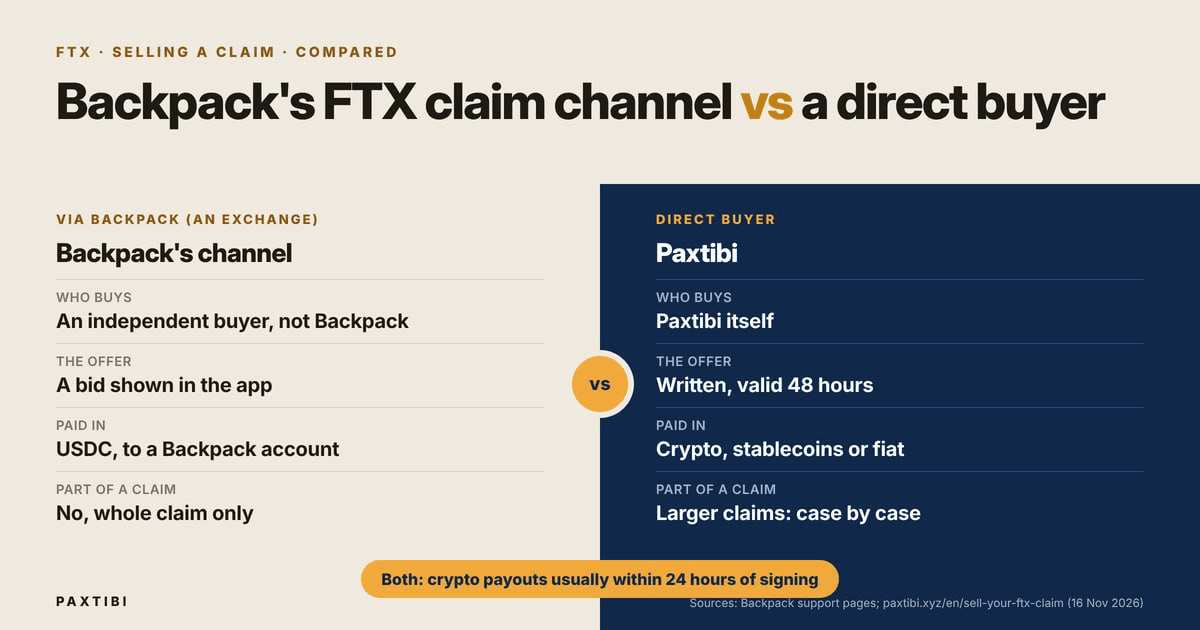
So the channel is a front door to one buyer, built into an exchange account. It is not a marketplace where several buyers compete, at least as Backpack describes it: the page shows one bid, under the status "Bid Received".
FTX EU: a separate Backpack process
Backpack says it acquired FTX EU, the Cyprus company that served some European customers; FTX disputes the acquisition (see below). This is unrelated to selling a claim.
- What it is. Backpack EU pays former FTX EU customers their balances. Withdrawals opened in May 2025 (see who pays which FTX payouts). Claims are "denominated and claimable only in EUR", after KYC with Backpack EU. Bank fees apply, from €8.
- Who it is for. Backpack EU's FAQ says EU residents who signed up before 7 March 2022 are not FTX EU customers, unless they later opened an FTX EU account. Those who signed up later generally are. Check your FTX terms of service to confirm.
- Two portals, possibly. Crypto and NFT claims go through claims.ftx.com, in the US case. If you have both kinds of claim, the FAQ says "you will need to use both claims portals".
- Sold claims. Backpack EU "is not involved in or responsible for any claims that have been sold or transferred to third parties".
- A dispute on record. In January 2025 FTX said the US court "did not approve the acquisition of FTX EU by Backpack", and that Backpack was not authorised to make distributions to FTX customers. Backpack replied that the Cyprus regulator, CySEC, approved its purchase in December 2024, and that "Backpack EU will be solely responsible" for paying former FTX EU customers. Both sides say the FTX estate is not responsible for funds owed by FTX EU to its former customers.
If your claim is an FTX EU euro balance, there is nothing to sell through Backpack's claims channel: claim it at Backpack EU. Everything below is about FTX International claims in the US process.
Who is on the other side of the deal
In the tables below, the right-hand column shows Paxtibi's terms. Other direct buyers set their own.
| Criterion | Backpack's channel | Direct buyer (Paxtibi) |
|---|---|---|
| Who buys your claim | An independent institutional buyer, not Backpack. Backpack's pages name it as FTX Creditor | Paxtibi. Our sell page: "Direct buyer using its own funds." |
| Who you sign with | The buyer: a Claim Transfer Agreement by DocuSign, which the buyer countersigns | Paxtibi: an assignment agreement, signed electronically |
| Who answers for the deal | Not Backpack, which disclaims responsibility; the buyer's own terms apply | Paxtibi |
| Who files the transfer in court | The buyer, under Rule 3001(e). Backpack's page does not mention it | Paxtibi files it and pays the $28 court fee |
Our point is not that one model is safe and the other is not. It is that you should know the name of the company that pays you, and hold its terms in writing, before you accept. With a direct buyer that is the buyer itself. With Backpack's channel it is a company that Backpack identifies only by name, a link and an e-mail address.
How the price is formed
What any buyer is paying for. When you sell, you sell the rest of your claim: the distributions FTX has not yet paid. The buyer pays you now and waits for them. Its price is a discount on that remaining value, for the wait and the risk. "No fee" does not change this. The buyer's margin is in the price, at Backpack's buyer and at Paxtibi alike.
Backpack's channel
- One bid. After you log in, the status shows either "Bid Received", with the total offer, or "Awaiting Offer". You click Accept if you are satisfied with the price.
- Small claims. The page says the buyer "may offer a lower price or bundle them" for claims under $10,000.
- Not published: how the bid is calculated, whether it is binding, and how long it stays open.
A direct buyer (Paxtibi)
- A written offer within 24 hours, valid for 48 hours. Our sell page calls it "a written, binding offer".
- The basis is stated: a percentage of the part of your allowed claim that FTX has not yet paid.
- The factors are stated: claim class, size, KYC status, the expected timing of the next payouts, and, where relevant, residence in a restricted country.
Neither Backpack nor Paxtibi publishes prices, and prices change with the timing of the next FTX payout. As of 16 November 2026 FTX has not announced a sixth record date (our estimate). The practical answer is to get at least two written offers for the same claim, on the same day, and compare the amount you would actually receive.
Fees, payment and speed
| Criterion | Backpack's channel | Direct buyer (Paxtibi) |
|---|---|---|
| Fee to the platform | None: "Backpack charges nothing" | No platform |
| Fee to the buyer | Not stated; the price is the bid | "No separate seller fee: the quoted price is what you receive" |
| Paid in | USDC, credited to your Backpack Exchange account | Crypto (BTC, ETH, XRP), stablecoins (USDT, USDC) or fiat; payment processing for restricted jurisdictions |
| When | After the buyer countersigns. "Most claims" within 24 hours of signing, "based on information provided to us"; larger claims may take longer | Stablecoins and crypto usually within 24 hours of signing, after a $10 test transaction; bank transfers at normal banking times |
| Before or after the court transfer | Before. The page links payment to the countersignature, not to the court | Before: "Payment does not wait for the court transfer" |
| Getting the money out | Withdraw USDC, or send a USD wire, from Backpack. Check Backpack's withdrawal fees | Paid to your wallet or bank account |
On speed the two are close. Both pay within about a day of signing for a standard claim. The real time differences come from elsewhere: KYC, missing documents, and a claim that needs review.
The court step is the same. Whoever buys files evidence of the transfer in FTX's case (No. 22-11068) under Bankruptcy Rule 3001(e). You then have 21 days to object. FTX pays a transferee only once the transfer is on the official claims register at a record date and the 21 days have passed without objection. Ask the buyer who keeps a distribution that arrives while the transfer is pending, and get the answer in the agreement.
What each route accepts
| Criterion | Backpack's channel | Direct buyer (Paxtibi) |
|---|---|---|
| Minimum | Claims above $500 | Not stated on our sell page; ask |
| Who can sell | Individuals only: "only individual (natural-person) claim holders are eligible" | Not stated on our sell page; ask |
| Part of a claim | No: "only sales of the full claim amount are supported" | For larger claims, reviewed case by case |
| Disputed claims | You can apply, also with a contingent claim; the buyer may ask for more documents | Disputed and pending claims reviewed case by case |
| What you hand over | Your claims.ftx.com e-mail, password and a 6-digit code from an authenticator app (e-mail 2FA is not supported), entered in Backpack | The Customer Code from Kroll's e-mail, to check the claim; then KYC and the agreement |
| KYC and forms | A verified Backpack account, then Sumsub: photo ID, live selfie, proof of address dated within 90 days (the troubleshooting section says only a valid passport is accepted). Then an IRS tax form when prompted | Sumsub, usually about 10 minutes |
| Bahamas process claims | Not through the app: you e-mail a request and give a Backpack deposit address | Yes. See how the PwC transfer works |
About your FTX login. Backpack's process logs in to your FTX Customer Portal with your own password and a one-time code; the page describes it as an automated process. Whether you are comfortable with it is your decision. Whichever route you take, never give anyone your seed phrase or private keys, and consider changing your FTX portal password once the sale is complete.
Restricted-country cases
The FTX list. As of 30 October 2026, FTX lists 43 entries where creditors cannot select a distribution service provider at Step 8 of the portal: 42 countries and territories and five regions of Ukraine. China and Russia are among them (see our country pages). FTX says distributions there are deferred. Its FAQ also warns that a holder who does not onboard with a provider within six months of a distribution date may forfeit distributions on the claim. See FTX restricted jurisdictions 2026.
Selling is one way out. A claim from a restricted country can be sold to a buyer in an eligible jurisdiction. After the transfer, the buyer receives the future distributions.
Backpack's channel. Launch coverage presented it as a route for creditors in China and Russia. Backpack's support page itself says nothing about restricted jurisdictions. You need a verified Backpack Exchange account, so first check that Backpack serves your country (its "Supported Regions" page), and ask the buyer in writing whether it buys claims of residents of your country.
Paxtibi. Our sell page says: "We buy claims from restricted jurisdictions, including China, Russia and Belarus." Residence can affect the offer. Payment processing is available for restricted jurisdictions.
The Bahamas process has its own list, kept by PwC, with 46 jurisdictions. See the PwC transfer.
When each option makes sense
| Your situation | Backpack's channel | Direct buyer |
|---|---|---|
| You are an individual with a standard FTX.com claim over $500, already use Backpack, and are happy to be paid in USDC there | Fits | Also fits; compare the two offers |
| The claim is held by a company | Not available | Ask |
| You want to sell part of a larger claim | Not available | Ask; Paxtibi reviews partial sales of larger claims |
| You live in a restricted country | Possible only if Backpack serves your country and the buyer confirms | Fits; Paxtibi buys these claims |
| You want payment in BTC, ETH, USDT or fiat to your own account | USDC to Backpack, then withdraw | Fits |
| You do not want to enter your FTX password and code anywhere else | Not possible: the process needs them | Fits |
| Your claim is in the Bahamas process | By e-mail request | Fits |
| You were an FTX EU customer with a euro balance | Not a sale: claim it at Backpack EU | Not a sale |
| You would rather keep the claim and wait | — | See payment processing |
Checklist before you accept any offer
Ask these questions of every buyer, Paxtibi included, and get the answers in writing.
- Who exactly buys the claim? The legal name, the country of registration, and who signs the agreement.
- Is the offer binding, and until when?
- What is the price a percentage of? The claim amount, or what FTX has not yet paid? How are distributions you have already received treated?
- What will you actually receive, after all fees, in which currency, and to which account?
- When are you paid: at signing, at countersignature, or after the court transfer?
- Who files the transfer under Rule 3001(e), and who pays the court fee?
- What happens to a distribution that arrives between signing and the transfer?
- What happens if the buyer does not countersign or pay? Are you then free to sell elsewhere?
- What do you have to hand over? Never a seed phrase or private keys. Decide knowingly about your portal password and 2FA codes.
- Can the buyer take your claim if you live in a restricted country, if it is disputed, or if you want to sell only part of it?
- Can you verify the buyer? See how to tell if a claim buyer is legitimate.
Our take
Backpack's channel is a convenient front door. If you already trade on Backpack and hold a standard FTX.com claim, it is quick to try, and Backpack takes no fee. But Backpack is an exchange, not a claims buyer. The price, the contract and the payment come from a separate company, which Backpack identifies only by name. The format is fixed: whole claims only, individuals only, USDC only, and your FTX login entered in the app.
A direct buyer is the counterparty itself. You know who pays you, you get the offer and its terms in writing, and non-standard claims can be discussed. That is our business, so weigh our view accordingly. The fairest test is simple: get a written offer from each route for the same claim on the same day, and compare what lands in your account.
FAQ
Does Backpack buy FTX claims?
No. Backpack is a crypto exchange. Its FTX claims channel passes your claim to an independent institutional buyer that is not affiliated with Backpack, and Backpack's pages name it as FTX Creditor. Backpack says it does not endorse or recommend the sale of FTX claims.
Does Backpack charge a fee to sell an FTX claim?
No. Backpack's support page says Backpack charges nothing. The buyer's margin is included in its bid, as with any claim buyer, so compare the amount you would actually receive.
How fast does Backpack pay for an FTX claim?
According to Backpack's support page, most claims are paid within 24 hours of signing the Claim Transfer Agreement, in USDC credited to your Backpack account, after the buyer countersigns. Larger claims may take longer.
Can I sell part of my FTX claim through Backpack?
No. Backpack's support page says only sales of the full claim amount are supported. It also says only individual claim holders are eligible and claims must be above $500.
Is the FTX EU claims process at Backpack the same as selling a claim?
No. Backpack EU pays former FTX EU customers their euro balances after KYC. That is a payout, not a sale. Crypto and NFT claims against FTX International go through the FTX Customer Portal in the US bankruptcy case.
Can I sell an FTX claim if I live in a restricted country?
Yes, to a buyer in an eligible jurisdiction, which then receives the future distributions. As of 30 October 2026, FTX lists 43 entries where creditors cannot select a distribution provider, including China and Russia. Backpack's support page does not address restricted jurisdictions; Paxtibi buys claims from China, Russia and Belarus.
Sources
- Backpack Exchange support, "Sell Your FTX International Claim via Backpack Exchange"
- Backpack Exchange, "Backpack Exchange Disclaimer re: FTX Creditor"
- Backpack Exchange support, "Supported Regions"
- Backpack Learn, "A brief history of Backpack", 24 December 2024
- Backpack EU, FTX EU claims FAQs (English)
- Backpack Learn, FTX EU EUR withdrawals, 15 May 2025
- FTX, "FTX Clarifies Certain Statements by Backpack Regarding Backpack's Purported Acquisition of FTX EU", 8 January 2025
- Backpack, "Backpack Responds to FTX Statement", 9 January 2025
- crypto.news, "Backpack launches FTX debt marketplace for claim holders", 18 July 2025
- FTX, "FTX Announces Fifth Distribution of Approximately $900 Million to Creditors on July 31, 2026", 17 July 2026
- FTX support, general information on distribution service providers
- Federal Rule of Bankruptcy Procedure 3001(e)
- Paxtibi, Sell your FTX claim
Disclaimer: this article is for information only and is not legal, tax or financial advice. Paxtibi buys bankruptcy claims and has a commercial interest in FTX claims. Paxtibi is not affiliated with Backpack, FTX Creditor or FTX. Backpack's terms are summarised from its public pages as of 16 November 2026 and may change.