
Two events: a distribution and a sale
A distribution is a payment by the FTX Recovery Trust on your allowed claim. Each round is a separate payment, on a separate date, at a separate exchange rate to your home currency.
A sale is a disposal of the claim to a buyer, at a price agreed today. After the transfer is recorded, the buyer receives the remaining distributions and you receive nothing more from FTX.
Why the difference matters. Tax systems usually tax payments of interest as income in the year they are received, and tax the sale of an asset as a gain or loss on the day of the sale. Whether a sale of an FTX claim counts as a sale of an asset, a sale of a debt or something else is exactly where the countries differ.
The part above 100% is interest
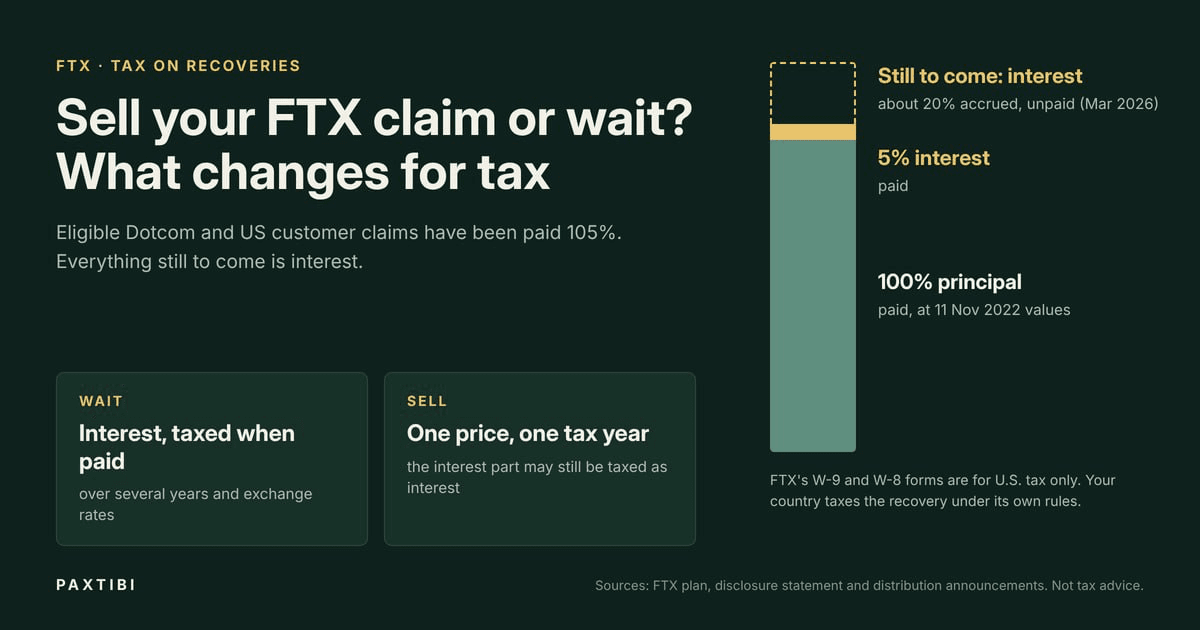
FTX dollarized every customer claim at its value on the petition date, 11 November 2022. The plan then pays interest on top, at the 9% "Consensus Rate", from the petition date to the distribution date. Under the plan's order of payments (section 4.2.3), the remaining principal of customer claims is paid before post-petition interest.
| Class | Projected total recovery (disclosure statement, 2024) | Paid so far (after 31 July 2026) |
|---|---|---|
| 5A Dotcom customer claims | 129%–143% | 105% |
| 5B US customer claims | 129%–143% | 105% |
| 6A general unsecured claims | 125% | 103% |
| 6B digital asset loan claims | 129%–143% | 103% |
| 7A–7C convenience claims | 119% | 120% (paid in full) |
Sources: the recovery table in FTX's disclosure statement and FTX's announcement of the fifth distribution. Projections are FTX's 2024 estimates, not a promise.
How much interest is left. The FTX Recovery Trust's Q1 2026 report shows interest accrued on Class 5A claims of $1.83 billion on $7.38 billion allowed, about 25%, at 31 March 2026, none of it paid by then. After the 5% paid on 31 July, roughly 20% of the claim amount had accrued and was still unpaid, which is less than FTX's 2024 range implied. How much more is paid, and when, depends on the Trust's remaining assets and reserves.
For a Dotcom or US customer claim, the first 100% returned the petition-date value, and the 5% above it was interest. Anything still to come is interest.
If you missed earlier rounds, for example because Step 7 or Step 8 was open, part of your principal is still unpaid. Check your status first: see our Step 7 guide.
Convenience claims are paid in a single distribution. For holders already paid, the tax events are behind them.
FTX's tax forms are for U.S. tax only
What the forms do. FTX asks every holder for a W-9 (U.S. persons) or a W-8 form (non-U.S. persons) in Step 7. FTX's support page says it reviews the form "to determine any applicable tax withholding consequences". The forms tell FTX whether to withhold U.S. tax and what to report to the IRS.
What they do not do. A W-8BEN is not filed with your home tax office and does not exempt you from tax at home. If you live in the UK or the EU, your own country decides how the recovery is taxed, whatever FTX withholds or reports in the U.S.
Non-U.S. holders and U.S. withholding. FTX's disclosure statement takes the position that interest paid to non-U.S. holders should generally not be U.S.-source income, and that with a W-8 on file U.S. withholding "should in any case not apply". It also warns that non-U.S. holders "may be subject to up to 30% withholding" where the rules require it.
U.S. holders who do not complete Step 7 risk forfeiting the round under plan section 7.14. Where a payment is made without a valid taxpayer identification number, the disclosure statement says backup withholding applies at 24%.
United States
The Effective Date exchange. FTX's final disclosure statement describes the plan as a taxable exchange of an old claim for a new claim against the wind-down entities. Its position is that a U.S. holder generally recognizes gain or loss equal to the fair market value of the claim on the Effective Date, excluding amounts attributable to interest, minus the holder's adjusted tax basis. The plan took effect on 3 January 2025. This is not automatically the claim's November 2022 value: the disclosure statement expected fair market value to approximate the amount used for voting. A capital loss may arise if that fair market value is below the holder's adjusted basis, assuming the claim is held as a capital asset. The disclosure statement says this tax treatment is uncertain and the IRS could take a different position.
Interest. Amounts paid as interest under the plan "should be treated as interest income", taxed at ordinary rates and subject to the net investment income tax where it applies.
What you receive. The FTX Recovery Trust's Q1 2026 report says holders "should have received a Form 1099-OID and/or Form 1099-INT" for post-petition interest "and a Form 1099-B in relation to payments on their Claim itself". The Trust says holders "are expected to be treated as holding indebtedness", and it refers to Form 1099-OID for "the accrual and/or payment" of post-petition interest. Under the original issue discount (OID) rules, interest can be taxable as it accrues rather than when it is paid, so check the 1099-OID figures with your adviser.
Theft-loss deductions. Personal theft losses are deductible only to the extent they are attributable to a federally declared disaster (from 2026, also a state-declared one), and the One Big Beautiful Bill Act made that limitation permanent. The exception is a theft in a transaction entered into for profit; IRS Chief Counsel Advice 202511015, a non-precedential memo on scam losses, applied that exception. In any case, a loss is not deductible while there is a reasonable prospect of recovery, and FTX is paying more than 100%.
Selling the claim. A claim held as a capital asset produces a capital gain or loss: the price minus your adjusted basis, long-term if held for more than a year. Because what remains on a customer claim is accrued interest, part of a sale price may be treated as interest, by analogy with the rule for bonds sold with accrued interest. OID you have already reported increases your basis. These points are not settled, so ask your adviser before you file.
United Kingdom
We found no HMRC guidance on FTX or on failed exchanges. When a taxpayer asked about distributions from another crypto lender's bankruptcy, HMRC's forum answer was to write in "with all the facts". The UK position therefore has to be built from general rules.
Crypto, or a debt? HMRC says theft is not a disposal, because "the individual still owns the stolen asset and has a right to recover it" (CRYPTO22450). An FTX claim, though, is now a fixed amount of U.S. dollars, and HMRC says "a debt exists whenever money is owed" (CG53400). Which description fits your position affects everything below.
Interest is likely savings income. The part above 100% is interest for the delay in payment, and HMRC's manual, citing case law, describes interest as compensation for being kept out of your money (SAIM2060). Interest from FTX is foreign savings income, taxed when received. The personal savings allowance is £1,000 for basic-rate taxpayers, £500 for higher-rate taxpayers and nil for additional-rate taxpayers. Budget 2025 raised savings income tax rates by 2 points from 6 April 2027 (to 22%, 42% and 47%), and Budget 2026 proposes a further 2 points from the same date, subject to legislation.
Selling the claim. If HMRC treats the claim as a simple debt in the hands of the original creditor, section 251 of the Taxation of Chargeable Gains Act 1992 applies: no chargeable gain and no allowable loss arise on its disposal, including its repayment. If it is another kind of asset, a sale is a disposal for capital gains tax at 18% or 24%, after the £3,000 annual exempt amount. HMRC has not said whether the part of a sale price that reflects unpaid interest is taxed as income. Do not rely on a capital treatment without advice.
Losses. A negligible value claim requires the asset to be "worth next to nothing" (CG13125). FTX claims have traded throughout and are being paid above 100%, so such a claim is unlikely to succeed.
Currency. Each U.S. dollar amount is converted to sterling at the rate on the day of the event (CG78310). HMRC does not treat cryptoassets as money, so stablecoins received as a payout are a new asset.
European Union: Germany, France, Italy and the Netherlands
We found no published guidance on FTX from any of the four tax authorities. The table shows the main readings; the notes below give the sources.
| Country | Interest above 100% | Selling the claim | Main open question |
|---|---|---|---|
| Germany | Likely capital income: 25% plus solidarity surcharge (26.375%), plus church tax where due, after the €1,000 saver's allowance | Money-claim reading: gain taxed at 26.375%. Crypto reading: tax-free after one year | Is the position a money claim (§20 EStG) or crypto (§23 EStG)? |
| France | Likely investment income at the flat tax: 30% in 2025, 31.4% from 2026 | No clear rule | Is the payout a sale of digital assets, a repayment of a claim, or compensation? |
| Italy | 26% as capital income, or in the same category as the claim | Gain taxed at 26% as a money claim, or 33% from 2026 if treated as crypto | Money claim or crypto-asset? |
| Netherlands | No separate tax | No separate tax | Value of the claim on 1 January (box 3) |
Germany. The finance ministry's 2025 crypto letter does not deal with exchange insolvencies. One reading keeps the position under the private-sales rule (§23 EStG), where gains are tax-free after one year. The other treats it, from the petition date, as a money claim under §20 EStG. Baumann Mayer Seidel, a German law firm, puts it plainly in its July 2026 note on FTX payouts: "you do not get your bitcoin back, but a payment on a money claim". It adds that the part above the claim may be taxable as capital income. On that reading, interest is capital income, repayments and sales are taxed at 26.375% in euros, and euro–dollar movements since November 2022 create gains or losses. A loss on a claim counts only once it is final that nothing more will be paid (Federal Fiscal Court, VIII R 13/15). Interest goes on Anlage KAP. Where the answer is unclear, a binding ruling (verbindliche Auskunft) is available.
France. The crypto gains regime (art. 150 VH bis CGI) covers sales of digital assets "or rights relating to them". Whether an FTX claim, now fixed in dollars, is such a right is untested. ORWL Avocats, a French law firm, argued in September 2026 that the principal may be non-taxable compensation and that the interest should follow it, but called the interest the point most likely to be challenged and noted that neither the tax administration nor a court has confirmed this view. The conventional reading taxes interest as investment income at the flat tax (PFU), which rose from 30% to 31.4% in 2026. Foreign interest also requires an advance payment on form 2778-SD within the first fifteen days of the month after it is received (lower-income households can be exempted from the 12.8% part, not from social charges). FTX and other digital-asset accounts go on form 3916-bis, and a payout account at a payment or e-money provider on form 3916. For a sale, no clear rule exists; a ruling request (rescrit) is one option.
Italy. If the claim is a money claim (art. 67(1)(c-quinquies) TUIR), gains on repayment or sale are taxed at 26%. If it is still a crypto-asset, the rate is 33% for gains realised from 1 January 2026. Late-payment interest takes the category of the underlying claim (art. 6(2) TUIR); the other reading taxes it as capital income at 26%. Losses can be carried forward for up to four years if reported in the year they arise. Without precise evidence of your original cost, the cost may be treated as zero.
Netherlands. A private holder is taxed only in box 3, on the value of the claim on 1 January, not on payments or a sale. For 2026 the deemed return on "other assets" is 6.00%, taxed at 36%, after an allowance of €59,357 per person. The Belastingdienst values a claim at what a buyer would pay for it. If your actual return was lower, for example in 2022 when FTX failed, you can ask to be taxed on the actual return; it is measured on your whole box 3 portfolio, not on the claim alone. A law to tax actual returns in box 3, including interest received, is before the Senate and is intended to apply from 2028.
Three worked examples
All three use the same claim. These are illustrations, not tax calculations.
The claim: an allowed $10,000 Dotcom customer claim, held by the original customer, with Steps 3, 7 and 8 complete.
Received so far: $10,500 (105%): $10,000 principal and $500 interest.
Option A, wait: on the Trust's March 2026 figures, about $2,000 of interest had accrued and was still unpaid after the July round. If it is paid in full, it arrives over an unknown number of rounds. This is our reading of the Trust's report, not a promise.
Option B, sell now: a buyer pays $1,500, that is 15% of the claim amount. This is an illustration, not an offer and not a market price.
Example 1: a U.S. individual
The $500 already received is ordinary interest income, reported on a Form 1099-INT or 1099-OID.
Wait: each further payment is interest income at your ordinary rate, in the year it is paid or accrues under the OID rules.
Sell: $1,500 in one tax year. Because the remaining entitlement is accrued interest, part or all of the price may be treated as interest rather than capital gain, and any OID you have already reported affects your basis. The sale mainly changes timing, certainty and paperwork.
Example 2: a UK higher-rate taxpayer
Wait: each further payment is likely foreign savings income, taxed at 40% above the £500 savings allowance, converted to sterling on each payment date. Payments after 6 April 2027 fall under the higher savings rates: 42% for higher-rate taxpayers under Budget 2025, or 44% if the Budget 2026 proposal is enacted.
Sell: HMRC has not ruled. If the claim is a simple debt held by its original creditor, section 251 means no capital gain and no loss. Whether HMRC would tax the interest element of the price as income is not settled. Get advice before you sell for tax reasons.
Example 3: a German private investor
Wait: each further payment is likely capital income at 26.375% (plus church tax where due), after the €1,000 saver's allowance, converted to euros on each payment date.
Sell: on the money-claim reading, the €-value of the $1,500, minus whatever cost the claim still carries, is taxed at the same 26.375%, once. On the crypto reading, a sale more than a year after acquisition is not taxable. Under the money-claim reading, then, the rate is the same either way; what changes is the amount, the year and the number of filings.
When a sale simplifies reporting
One date, one rate, one record. A sale gives one price, one exchange rate and one contract. Waiting gives a series of distributions, each with its own date, rate and, for U.S. holders, its own tax forms.
No future filings tied to FTX. In France, each interest payment from abroad triggers its own advance payment. In Germany and Italy, each repayment is a separate event in euros. A sale closes the file in one tax year.
Certainty of the amount. The tax on future interest depends on how much FTX pays and when. A sale fixes the amount today.
What a sale does not do. It does not erase tax on what you have already received, it does not restore a forfeited round, and it does not necessarily turn interest into a tax-free or lower-taxed gain. Compare the after-tax result of both options with your adviser.
Documents to keep
- the allowed amount of your claim and your class (the FTX claims portal and your claim schedule);
- FTX's distribution notices, and any Forms 1099 the Trust sends;
- for each payment: the date, the amount, the currency, and the exchange rate you used;
- records of what your crypto originally cost, if your country uses it as the cost of the claim;
- if you sell: the signed transfer agreement, the payment record, and the notice of transfer filed with the court.
Our take
From here on, an FTX customer claim mostly pays interest, and interest is the part most tax systems tax as income. Selling replaces several years of interest, each taxed when paid, with one price in one tax year. Whether that is better after tax depends on where you live, your tax rate and what your tax office decides, so ask an adviser with the numbers in hand. What the forms FTX collected cannot tell you is how your own country will see it.
For the latest dates, see our FTX payment update and sixth-distribution estimate. Before selling, read how to verify a claim buyer.
FAQ
Are FTX distributions taxable?
It depends on where you live. In the U.S., FTX's disclosure statement treats the plan as a taxable exchange at the 2025 Effective Date and the interest as ordinary income. In the UK, Germany, France and Italy the interest is likely taxable as income, while the treatment of the principal depends on how each country classifies the claim. In the Netherlands, private holders are taxed only through box 3.
Is the part above 100% of my FTX claim taxed as interest?
Under the FTX plan it is post-petition interest at the 9% Consensus Rate, paid after the principal. The U.S. treats it as interest income, and in the UK, Germany, France and Italy it is likely taxed as interest or investment income. The Netherlands taxes it only through box 3.
Does the W-8BEN I gave FTX decide my tax at home?
No. The W-9 and W-8 forms are for U.S. tax purposes: they decide U.S. withholding and reporting. Your home country taxes the recovery under its own rules, whatever FTX withholds or reports in the U.S.
Is selling my FTX claim taxed differently from receiving distributions?
Sometimes. A sale puts the result in one tax year at one exchange rate, but in several countries the part of the price that reflects unpaid interest may still be taxed like interest. We found no published guidance on FTX from the tax authorities of the UK or the four EU countries we cover, so ask an adviser before relying on a different treatment.
Can I claim a tax loss on FTX?
A theft-loss deduction is unlikely: FTX is paying more than 100% of the claim amount, and U.S. personal theft losses are deductible only in limited cases. Under FTX's final disclosure statement, a U.S. holder may instead have recognized a capital loss in 2025 if the claim's fair market value on 3 January 2025, excluding interest, was below the holder's adjusted tax basis. That value is not automatically its November 2022 value, and the disclosure statement warns that the tax treatment is uncertain. In Germany a loss on a claim counts only once it is final, and in the UK a negligible value claim is unlikely to succeed.
What tax forms will I get from FTX?
The FTX Recovery Trust says U.S. holders should receive Form 1099-INT or 1099-OID for post-petition interest and Form 1099-B for payments on the claim. Non-U.S. holders should not expect a statement for their home tax office, so keep your own records of each payment.
Sources
- FTX, General Information on Tax Requirements
- FTX, Disclosure Statement for the Joint Chapter 11 Plan (D.I. 19143), section 8, PDF pages 175–179
- FTX, confirmed Second Amended Joint Chapter 11 Plan (D.I. 26029), section 4.2.3(g)–(h), PDF pages 38–39
- FTX Recovery Trust, Q1 2026 financial report (D.I. 35691)
- FTX, fifth distribution announcement, July 2026
- FTX, Effective Date announcement, 3 January 2025
- IRS, Casualty loss deduction expanded and made permanent
- IRS, Chief Counsel Advice 202511015
- HMRC, Cryptoassets Manual CRYPTO22450 (theft)
- HMRC, Capital Gains Manual CG53400 (debts)
- Taxation of Chargeable Gains Act 1992, section 251
- HMRC, Savings and Investment Manual SAIM2060 (interest)
- gov.uk, Tax-free interest on savings
- gov.uk, Capital Gains Tax rates and allowances
- gov.uk, Changes to tax rates for property, savings and dividend income (Budget 2025)
- gov.uk, Budget 2026, rates and allowances
- Germany, Income Tax Act §20 and §23
- Germany, Income Tax Act §20 and §23
- Baumann Mayer Seidel (Kryptoanwalt.de), taxing payouts from crypto insolvencies, 23 July 2026
- ORWL Avocats, tax on FTX and Mt. Gox repayments for French creditors, 28 September 2026
- France, BOFiP on gains from digital assets
- Italy, Law 207/2024 (2025 budget law)
- Netherlands, Belastingdienst, box 3 calculation for 2026
- FTX, General Information on Income Tax Forms
General information, not tax advice. This article describes how the rules and FTX's documents read on 23 November 2026. Tax depends on your facts and your country, and we found no published guidance on FTX from the tax authorities of the UK, Germany, France, Italy or the Netherlands. Ask a tax adviser before you file or sell. Paxtibi buys bankruptcy claims and offers payment processing, so we have a commercial interest in this topic.