
What Step 7 is
Where it sits. Step 7, "Distributions – Tax Requirements", comes after KYC (Step 3) and before Step 8, "Distributions: Select Agent", where you choose and onboard with a payout provider. FTX requires KYC and the tax form before you can onboard with a provider.
Why FTX asks for it. FTX says the form is reviewed prior to distributions "to determine any applicable tax withholding consequences". For details on withholding, it refers holders to the plan's disclosure statement and Kroll's FAQs.
Where it is submitted. Holders submit it only in the portal. Asked whether the form can be sent by e-mail, FTX's support page answers "No".
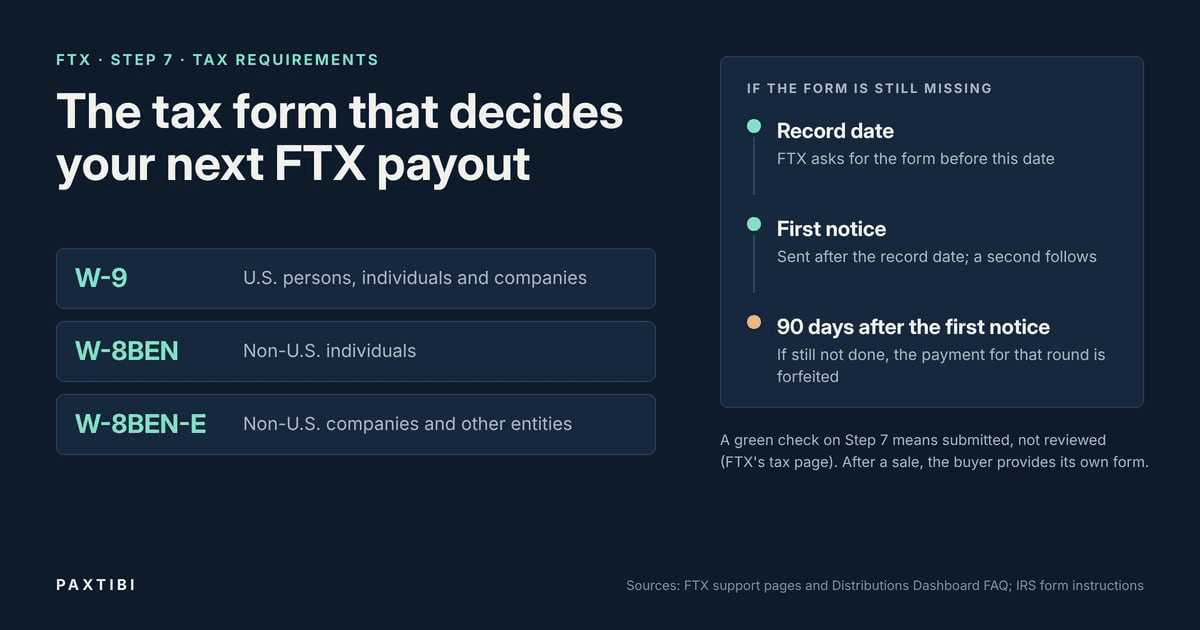
What the green check means. FTX's tax page says the check on Step 7 "does not designate that your tax form has been reviewed". Its page on payout providers says approvals for KYC and tax are shown with a green check once the review is complete. Treat the check as proof that you submitted the form, not that it was approved.
W-9, W-8BEN or W-8BEN-E: which form you need
| You are | Form |
|---|---|
| An individual who is a U.S. tax resident | W-9 |
| A non-U.S. individual | W-8BEN |
| A U.S. company or other U.S. legal entity | W-9 |
| A non-U.S. company or other entity | W-8BEN-E |
| A non-U.S. intermediary or flow-through entity receiving the distribution for others | W-8IMY |
| A non-U.S. government, tax-exempt or similar organisation | W-8EXP |
| A non-U.S. entity whose income is effectively connected with a U.S. trade or business | W-8ECI |
Source: FTX's table in "General Information on Tax Requirements". FTX's list of U.S. tax residents starts with U.S. citizens, excluding residents of U.S. territories. The IRS adds that a U.S. citizen uses W-9 "even if you reside outside the United States", and that an entity uses W-8BEN-E, not W-8BEN.
If you are unsure whether you count as a U.S. person for tax purposes, or you live in a U.S. territory, ask a tax adviser before you sign. The form is signed under penalties of perjury.
Why a tax form fails
FTX does not publish a list of rejection reasons. But a payer cannot rely on a form that fails IRS rules, and these are the rules that are easiest to get wrong.
Wrong form for your status. A company on W-8BEN instead of W-8BEN-E; a U.S. citizen living abroad on W-8BEN instead of W-9; someone receiving funds for others on W-8BEN instead of W-8IMY.
Wrong name or wrong signer. A W-8BEN must be signed by the beneficial owner of the payment: for FTX, the individual who holds the claim and passed KYC. A company uses W-8BEN-E, signed by someone authorised to sign for it. If an agent signs, the IRS requires the power of attorney (or a copy) to be attached and says the agent should check the capacity box.
Address problems. Line 3 of the W-8BEN must be your permanent residence. The IRS says not to show "the address of a financial institution, a post office box, or an address used solely for mailing purposes". A move to a U.S. address is a change in circumstances that requires a new form.
Foreign tax number. The W-8BEN asks for your foreign tax identification number on line 6a, and in certain cases it is required. The IRS lists exceptions: no number is needed if your country is on the IRS list of jurisdictions that do not issue tax numbers, and if you are not legally required to have one you check box 6b instead. If you have a tax number, giving it avoids the question.
Information that contradicts what the payer already holds. Under IRS rules, a payer may not rely on a form that is incomplete on any item relevant to the claims made, that "contains any information that is inconsistent with the claims made", or that its own records contradict. If your form and your KYC disagree, for example on your name or country, the form may not be accepted.
A signature that is not a signature. The IRS allows electronic signatures, but "simply typing your name into the signature line is not an electronic signature". Use the signing flow the portal provides.
An outdated W-8. A W-8 form is generally valid until the last day of the third calendar year after the year it was signed. A W-8BEN signed in 2024 generally expires on 31 December 2027. If any information on it becomes incorrect, you must submit a new form within 30 days.
A treaty claim (Part II of the W-8BEN) is optional. If you are not sure a treaty applies to you, leave it to a tax adviser rather than guess.
The 90-day clock, and how to find your notice date
The real deadline is the record date. FTX's distribution announcements ask holders to "submit the required tax forms" prior to the record date. The 90 days below is the point after which the payment is lost, not extra time.
The plan. Section 7.14 of the FTX plan requires holders, on request, to provide a tax form before a distribution. If the request is not met within 30 days, FTX sends a second request. If that is not met within 60 days, the holder "shall be deemed to have forfeited its right to receive Distributions", and the forfeited amounts go back to the estate.
How FTX applies it. FTX's Distributions Dashboard FAQ applies the rule round by round: after each record date, original holders who have not met the tax requirement receive two notices, and a form not completed within 90 days of the first notice forfeits the distribution tied to that record date.
Finding your start date. The clock starts with FTX's first notice, not with the record date. Search the e-mail address registered on your FTX account, including spam, for FTX's messages about tax requirements after the record date. The notice comes after the record date, so the window cannot close earlier than 90 days after it.
| Round | Record date | Payout | 90 days after the record date (earliest close) |
|---|---|---|---|
| 4th | 14 Feb 2026 | 31 Mar 2026 | 15 May 2026 |
| 5th | 16 Jun 2026 | 31 Jul 2026 | 14 Sep 2026 |
| 6th | Not announced | Not announced | — |
If FTX's first notice after 16 June 2026 was sent to you and your Step 7 was still open 90 days later, the July 2026 payment is forfeited. Fix the form before the next record date. We track the sixth date on our payment update page and estimate it in our sixth-distribution article.
Checking your status in the portal
Log in at claims.ftx.com and open Step 7. A green check shows the form was submitted; FTX's tax page says it does not mean the form was reviewed.
Check that Step 3 (KYC) and Step 8 are complete too. Step 8 is complete only when it shows "Onboarding Complete"; selecting a provider is not enough. A completed tax form does not help if Step 8 is open: see our Step 8 guide.
If FTX asks for a corrected form, submit it in the portal straight away. Do not assume the window pauses while you fix it.
If you believe you met the deadline but a payment shows as forfeited, collect the evidence (FTX's e-mails, portal screenshots with dates) and raise it in writing through FTX's support centre.
What is forfeited: one round, or the claim?
The payment for that record date. Under FTX's Distributions Dashboard FAQ, the forfeiture applies to the distribution for that record date. FTX's announcements ask holders to complete the steps before a record date to be paid in that round, so a form completed before the next record date counts for the next round.
The plan's wording is broader. Section 7.14 speaks of forfeiting "its right to receive Distributions". Do not treat later rounds as safe: finish Step 7 now, not at the next notice.
Convenience classes. Claims in classes 7A, 7B and 7C (the convenience classes) are paid in a single distribution. FTX's tax page says these holders, if they do not meet the second request within 60 days, "will forfeit their rights to receive the entirety of their distribution". FTX's page on payout providers also cites a six-month limit from the first record date, 3 January 2025, under plan section 7.8. If you hold a convenience claim and Step 7 is still open, check your status with FTX support.
Step 8 has its own, wider rule. FTX's Distributions Dashboard FAQ says a holder who does not onboard with a payout provider within six months of the first distribution date associated with the allowed claim "may forfeit their right to receive distributions" on that claim.
A forfeited payment does not come back. Neither a late form nor a sale restores it. See forfeited distributions and failed KYC for the other statuses.
Selling a claim with Step 7 unresolved
Who submits the tax form after a sale. FTX's support page is direct: for customer claims sold to third-party buyers, "it is the claims buyers' responsibility to provide an applicable tax withholding form", through FTX's claim buyer communication process. Asked whether the seller still needs to complete the form in that case, FTX answers "No".
When the buyer is paid. FTX pays a transferred claim to the buyer if the buyer is on the official claims register as of the record date and the 21-day notice period has passed without objection. For a given round, the transfer must be on the register by that round's record date.
What a sale cannot fix. A round already forfeited stays forfeited. If KYC (Step 3) was never passed, read our article on failed KYC first.
What it means in practice. If KYC is done and your claim is allowed, an open Step 7 does not prevent a sale. A buyer prices the rounds still to come and provides its own tax form for them.
What Paxtibi does. We buy FTX claims directly, with our own capital, including claims where Step 7 or Step 8 is incomplete, after we check which rounds have been paid or forfeited. We send a written offer within 24 hours. See how selling an FTX claim works and how to check that a buyer is legitimate.
Bahamas claims. If your claim is in the Bahamas liquidation of FTX Digital Markets, the liquidators run a separate process, including a separate tax stage. See our Bahamas claim guide.
What not to do
Do not send your tax form or tax number by e-mail, to FTX or to anyone who contacts you about it. Holders submit the form only in the portal.
Do not let someone else sign as you without a power of attorney attached to the form.
Do not guess a treaty claim to reduce withholding. The form is signed under penalties of perjury.
Do not pay anyone to "unlock" Step 7. It is done in the portal, at no cost.
Our take
Step 7 looks like paperwork, but it decides whether the next payment reaches you. Check it now, not when the sixth record date is announced: confirm you used the right form, that the name and country match your KYC, that a W-8 is still within its validity period, and that Step 8 shows "Onboarding Complete". If the paperwork is more than you want to manage, selling the claim moves the tax form to the buyer.
FAQ
What is Step 7 in the FTX claims portal?
Step 7 is "Distributions – Tax Requirements", where you submit a U.S. tax form. Individuals and companies use W-9 if they are U.S. persons, and W-8BEN or W-8BEN-E if they are not. FTX reviews the form prior to distributions.
Should I use W-9 or W-8BEN for my FTX claim?
Use W-9 if you are a U.S. citizen (even if you live abroad) or a U.S. resident, and for a U.S. company. Use W-8BEN if you are a non-U.S. individual, and W-8BEN-E for a non-U.S. company. If you are unsure of your tax status, ask a tax adviser before signing.
Step 7 shows a green check. Is my tax form approved?
Not necessarily. FTX's tax page says the green check shows that the form was submitted, not that it was reviewed. FTX reviews the form prior to distributions.
What happens if I miss the FTX tax form deadline?
FTX asks for the form before the record date. Under its Distributions Dashboard FAQ, original holders who have not completed it receive two notices after the record date, and a form not completed within 90 days of the first notice permanently forfeits the distribution for that record date.
Can I get a forfeited FTX distribution back by submitting the form late?
No. A late form can count for later rounds if it is done before the next record date, but the forfeited payment goes back to the estate.
Who submits the tax form if I sell my FTX claim?
The buyer. FTX says that for customer claims sold to third-party buyers, it is the buyer's responsibility to provide the tax form, through FTX's claim buyer process. A round already forfeited before the sale stays forfeited.
Sources
- FTX, General Information on Tax Requirements
- FTX, General Information on Distribution Service Providers
- FTX, Distributions Dashboard FAQs
- FTX plan, section 7.14, as quoted in Kroll's affidavit of service (D.I. 30642, 5 June 2025)
- FTX, "FTX Sets Next Distribution Date and Amends Proposed Disputed Claims Reserve Reduction", 26 May 2026
- FTX, fifth distribution announcement, 17 July 2026 (republished)
- CoinDesk, FTX sets the 31 March 2026 payout for holders on record as of 14 February, 14 January 2026
- IRS, Instructions for Form W-8BEN (Rev. October 2021)
- IRS, Instructions for the Requester of Forms W-8BEN, W-8BEN-E, W-8ECI, W-8EXP and W-8IMY (Rev. June 2022)
- IRS, Instructions for the Requester of Form W-9 (Rev. March 2024)
- Paxtibi, FTX payment update
Disclaimer: this article is for information only and is not legal, tax or financial advice. Paxtibi buys bankruptcy claims and offers payment processing, so we have a commercial interest in this topic.