
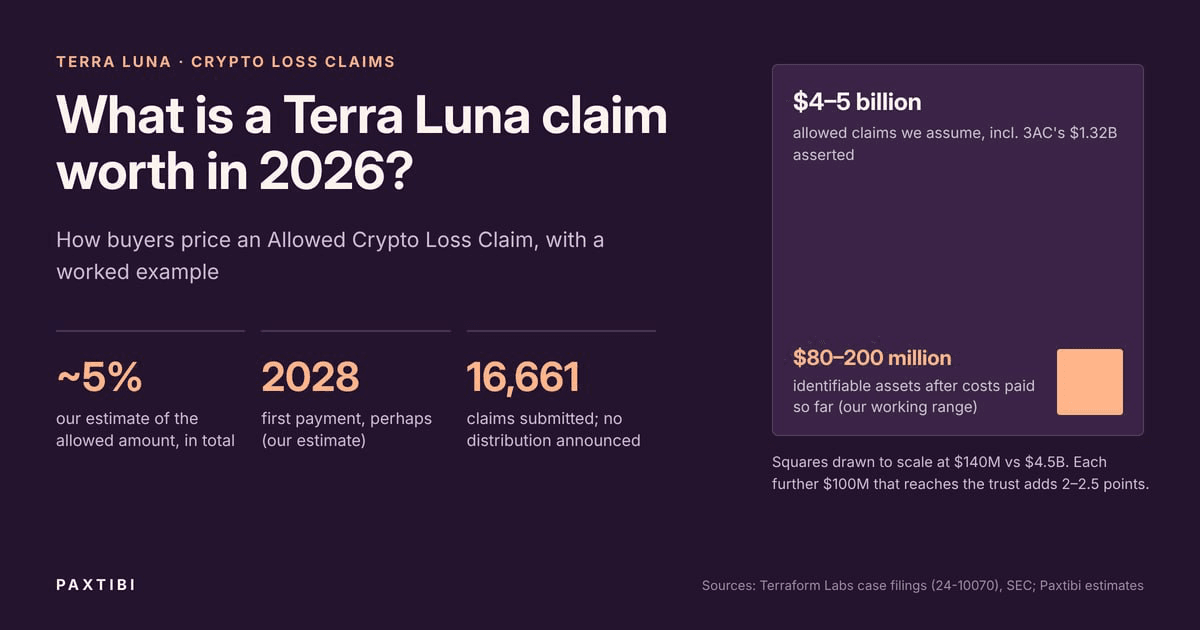
The allowed amount is not the cash value
How the amount is set. Under the court's procedures, the claim starts from what you paid to acquire the eligible Terra tokens. Amounts in other currencies or tokens are converted into US dollars at the exchange rates of the petition date, 21 January 2024. The tokens themselves are "presumed to be worthless as of the Petition Date".
What "allowed" means. The Plan Administrator reviews each claim and issues an Initial Determination. If you accept it, or do not dispute it within 30 days of receipt, it becomes an Allowed Crypto Loss Claim. If you dispute the Initial Determination in the claims portal within 30 days of receipt, the Plan Administrator issues a Final Determination. To challenge the Final Determination, you must dispute it in the portal within 30 days of receipt and file an objection in court within 90 days of receiving it.
What it gives you. A right to share in distributions from the Wind Down Trust, alongside other allowed Crypto Loss Claims. It is not a promise of any amount.
So two claims with the same allowed amount receive the same share of any distribution. Both receive only a fraction of that amount, and the fraction depends on three things: what the trust collects, what it spends and how many claims share in it.
For the claims process step by step, see Terra/Luna Crypto Loss Claims explained.
What the estate has to pay out
We track case events on our Terra Luna payment update. Here is what the trust has, or may get.
| Item | Amount | What we know |
|---|---|---|
| Selected assets in the September 2024 balance sheets | About $213.3 million in selected book assets: cash $76.5M, venture investments $102.9M, prepayments $33.8M (components rounded) | These are historical book values, not current cash available for distribution. The earlier liquidation analysis valued venture investments at $17.6M–$97.5M and prepayments at $0–$4M. |
| Estimate at plan approval (September 2024) | $184.5M to $442.2M in total | For all stakeholders. Terraform said the total value of eligible crypto losses was "impossible to estimate" |
| PYTH tokens | 500 million tokens, received in May 2025 | They were the co-founder's tokens, returned under the SEC settlements, and are intended for Crypto Loss Claims. At about $0.0568 per token (19 November 2026), 500 million tokens would be worth about $28.4 million if all are still held. |
| Singapore class-action escrow | About $56.9M was deposited with the Singapore court; about $25M has now been released to the Plan Administrator | The Fourth Status Update confirms the release for the general benefit of the trust and ordinary Crypto Loss Claim holders. Further trials are scheduled for December 2026 and early 2027; remaining escrow recoveries are uncertain. |
| The co-founder's obligation | The SEC judgment requires him to transfer at least $204.3 million to the estate, including $7 million in cash | The PYTH tokens came to the trust under the same SEC settlements, so they are likely part of this amount, not in addition to it. How much of the rest has been, or can be, collected is not public |
| Lawsuits against Jump and Jane Street | At least $4 billion sought from Jump; no amount stated for Jane Street | The Fourth Status Update says dismissal briefing in Jump continues into late 2026. Jane Street dismissal motions were fully briefed in mid-July, with a hearing scheduled for 21 December 2026. No merits ruling is reported in that update. |
| Total cash disbursements | $65.2 million since the plan took effect, to 30 September 2026 | Running costs and professional fees come out of the pot before any distribution |
One more line matters, because it is often misread. Under the SEC's final judgment Terraform owes $4.47 billion in disgorgement, interest and penalties. The SEC will not receive any of it "unless and until investors and creditors are paid in full". So the SEC's claim does not compete with yours. It is not money coming to you either.
How big is the claims pool?
Filed. The earlier count was 15,980 forms by 16 May 2025 plus 660 in the reopened window from 1 October to 24 November 2025. The Fourth Status Update of 13 November 2026 (D.I. 1392) now lists 16,661 submitted claims and 15,251 eligible for review, after withdrawals, replacements and voided claims.
Decided. The Fourth Status Update reports 14,791 Initial Determinations: 13,185 accepted (89.1%), 1,466 disputed (9.9%) and 140 pending a response (1.0%). It says initial determinations cover about 97% of claims eligible for review. During reconciliation, 5,285 claimants were asked for additional information; most supplied it. No final dollar total of allowed claims is given.
Three Arrows Capital. The fund's liquidators had filed a claim of $1.32 billion. Under a court-approved agreement of 7 October 2025, the claim is to be pursued as a Crypto Loss Claim, with the same priority as yours. The order allowed no amount. If a large part of it is allowed, every other claim's share shrinks.
Our working assumption: allowed Crypto Loss Claims of $4–5 billion in total, including whatever 3AC is allowed. This is our assumption, not a published figure. It drives the estimate below.
Litigation: the upside, and its cost
Jump. Filed on 18 December 2025 in the Northern District of Illinois, seeking at least $4 billion. It alleges a secret arrangement to support UST and the transfer of about $1.5 billion of Bitcoin reserves. Jump moved to dismiss the amended complaint on 19 August 2026. See our article on the motion.
Jane Street. Filed on 23 February 2026 in the Southern District of New York, alleging insider trading and market manipulation during the collapse. Jane Street moved to dismiss in April 2026. The trust amended its complaint in May, alleging trading profits of more than $134 million. The Fourth Status Update confirms that dismissal motions were fully briefed by mid-July and a hearing is scheduled for 21 December 2026.
What it means for value. Both suits remain unresolved in the Fourth Status Update. Dismissal could remove that upside. A win or settlement could take years, and legal costs come first. An amount claimed in a lawsuit is not money in the trust.
Our estimate: about 5%, and why
We estimate that holders of allowed Crypto Loss Claims will receive about 5% of the allowed amount in total, with a first payment perhaps in 2028. Here is the arithmetic.
| Recovery on allowed claims | Pool $4 billion | Pool $5 billion |
|---|---|---|
| Identifiable assets after costs paid so far: about $80 million (low case) | 2.0% | 1.6% |
| Identifiable assets after costs paid so far: about $200 million (high case) | 5.0% | 4.0% |
| Each further $100 million that reaches the trust, net of costs | +2.5 points | +2.0 points |
Where the range comes from. The high case starts with selected historical book assets of about $213.3 million, adds about $28.4 million for PYTH at the 19 November 2026 price and the confirmed $25 million escrow release, and subtracts $65.2 million in recorded cash disbursements: approximately $201.5 million. The low case uses the lower liquidation values for venture investments ($17.6 million) and prepayments ($0) on the same basis: approximately $82.3 million. Neither case deducts running costs from now until a distribution; they will reduce both. These mixed-date illustrations are not a current balance sheet or an official forecast. The $25 million release replaces, rather than adds to, the previously anticipated $44 million escrow recovery; the PYTH is not added again through the co-founder’s obligation.
Why about 5%. The identifiable assets alone point to roughly 1.6–5%. We add a modest allowance for the upside: some collection on the co-founder's obligation and some value from the lawsuits, for example through a settlement. We do not count on the full amounts claimed. Collecting from an individual serving a prison sentence is uncertain, and the lawsuits may be dismissed or end late, after costs.
What would change our view: a ruling on the motions to dismiss, any collection on the co-founder's obligation, the sale price of the PYTH tokens, and the dollar total of allowed claims once the Plan Administrator publishes it.
Our estimate can be wrong in either direction. No official recovery estimate exists, and none should be read into this one.
How a buyer turns this into a price
A buyer pays you today for what your claim may pay in the future. Any serious offer starts from the same four questions:
What will the claim pay in total? This is our ~5%, or the buyer's own estimate.
When? Money in 2028 or later is worth less today. The longer the wait, the bigger the discount.
How sure is it? The pool size, the lawsuits and the co-founder's obligation can move the outcome a lot. Buyers price that uncertainty.
Is this claim clean? An allowed claim with completed KYC is worth more than one still under review or disputed. Small claims cost relatively more to transfer and track.
That is why offers for Terra claims are a fraction of the allowed amount, and why different buyers quote different numbers: they make different assumptions about the pot, the pool and the timing. Ask any buyer to show you how it got to its number.
Upfront payment plus retained upside
Why this structure exists. A straight sale gives you certainty now and gives the buyer all of the upside. If the lawsuits or the collection effort pay off, that upside could be large compared with the base case.
How it works. You receive an upfront payment now, and the agreement lets you keep part of what the claim pays above an agreed level.
What Paxtibi does. We buy Terra claims directly, with our own capital. We can structure a deal so that you receive money upfront while keeping potential upside. Terms vary by claim: we review the claim and propose the upfront amount and whether upside participation can be included. See how selling a Terra claim works.
A worked example
Take an allowed claim of $20,000.
| Outcome for allowed claims | What the claim pays in total |
|---|---|
| Low case, pool $5 billion (1.6%) | $320 |
| Low case, pool $4 billion (2.0%) | $400 |
| High case, pool $5 billion (4.0%) | $800 |
| High case, pool $4 billion (5.0%) | $1,000 |
| Each further $100 million that reaches the trust (+2.0 to +2.5 points) | +$400 to +$500 |
Our central estimate of about 5% means about $1,000 on this claim.
If you keep the claim, you receive these amounts if and when the trust distributes them, and you carry all the risk.
If you sell outright, you receive the buyer's price now, and the buyer takes all the outcomes above.
If you sell upfront plus upside (illustrative terms only, not an offer): suppose the agreement sets the level at 5% of the allowed amount, which is $1,000, and gives you half of anything the claim pays above it.
| Total paid on the claim | Above the level | Your extra share | You receive in total |
|---|---|---|---|
| 4% ($800) | $0 | $0 | The upfront payment |
| 5% ($1,000) | $0 | $0 | The upfront payment |
| 10% ($2,000) | $1,000 | $500 | The upfront payment + $500 |
| 20% ($4,000) | $3,000 | $1,500 | The upfront payment + $1,500 |
The upfront payment, the level and the share are agreed claim by claim.
Risks
Distribution record date. The Fourth Status Update says the record date for distributions has not been set. If you sell, the agreement should say who receives a distribution if the transfer has not been recorded by then, and that it must be passed on.
Your claim can still change. Claims under individualized review, or disputed, can end at a lower amount, or at nothing.
The pool can grow. A large allowed 3AC claim, or more allowed claims than expected, reduces every share.
Costs keep running. Every quarter of administration and litigation is paid from the pot.
The upside may not come. The lawsuits may be dismissed, and the rest of the co-founder's obligation may never be collected.
Asset values move. The PYTH tokens are worth what the market pays when they are sold.
Payment logistics. The court's procedures warn that distributions to some claimants "may be impossible", for example where they cannot receive US dollars. Keep your KYC and contact details current with Kroll.
Scams. The SEC has warned about phishing e-mails from donotreply@ra-kroll.com, which is not a Kroll address. Never share your seed phrase, private keys or passwords, and never pay upfront fees to anyone. See how to tell if a claim buyer is legitimate.
Our take
An Allowed Crypto Loss Claim is a real claim, but its value is set by arithmetic the e-mail does not show: a pot of about $80–200 million against claims we assume total $4–5 billion. On today's facts, about 5% of the allowed amount is a fair central estimate. Most of the upside lies in uncertain places: an obligation owed by an individual and two lawsuits at an early stage.
If you can wait until 2028 or later and want the full upside, keep the claim. If you want money now, compare written offers and ask each buyer to show its method. If you want both, ask for upfront payment plus a share of the upside.
FAQ
What is a Terra Luna claim worth in 2026?
No official estimate exists, and no distribution to Crypto Loss Claims has been announced. We estimate that allowed Crypto Loss Claims will receive about 5% of the allowed amount in total, with a first payment perhaps in 2028. More depends on how much of the co-founder's $204.3 million obligation is collected and on the trust's lawsuits against Jump and Jane Street.
What does Allowed Crypto Loss Claim mean?
It means the Plan Administrator has reviewed your claim and issued an Initial Determination, and you accepted it or did not dispute it within 30 days. A disputed claim is allowed only at the amount fixed when the dispute is resolved. The allowed amount fixes the size of your claim in the Terraform Wind Down Trust. It is not a payment notice.
Will I be paid my allowed amount?
Almost certainly not in full. Allowed claims share in what the Wind Down Trust collects after costs. On our working figures its identifiable assets come to about $80–200 million, against claims we assume total $4–5 billion. Three Arrows Capital alone asserted $1.32 billion.
When will Terra Luna Crypto Loss Claims be paid?
No distribution date has been set, and no distribution to Crypto Loss Claims has been announced. Our estimate is that a first payment may come in 2028, but it depends on the claims review, the costs and the lawsuits.
How do buyers price a Terra Luna claim?
A buyer estimates what the claim will pay in total, when, and how certain that is, then pays a discount for the wait and the risk. Whether the claim is allowed, its size and KYC status also matter. Ask any buyer to explain its method in writing.
Can I sell a Terra claim and keep some of the upside?
Yes, with some buyers. Paxtibi can structure a sale so that you receive money upfront and keep part of what the claim pays above an agreed level. Terms vary by claim.
Sources
- Order setting the bar date and approving Crypto Loss Claims procedures, 12 March 2025
- Notice of extension of the Crypto Loss Claims bar date to 16 May 2025 (Doc. 986)
- Plan Administrator’s Fourth Status Update, 13 November 2026 (D.I. 1392)
- September 2024 balance sheets, D.I. 802-1, page 4
- Plan Administrator's Second Status Update, 21 September 2025 (D.I. 1086)
- Plan Administrator's Third Status Update, 17 February 2026 (D.I. 1177)
- Order approving the stipulation with Three Arrows Capital, 7 October 2025 (D.I. 1117)
- Post-confirmation report for the quarter to 30 September 2026 (D.I. 1376)
- SEC, SEC v. Terraform Labs: information for harmed investors
- Terraform Labs Plan Administrator (lawsuits and updates)
- The Block, "Jane Street asks court to dismiss Terraform Labs' insider trading lawsuit", 23 April 2026
- Decrypt, on the amended complaint against Jane Street, 21 May 2026
- Decrypt (Reuters), "Terraform Labs Could Pay Up to $442 Million as Bankruptcy Judge Approves Wind Down", 20 September 2024
- CoinGecko, Pyth Network price
- Paxtibi, Terra Luna payment update
Disclaimer: this article is for information only and is not legal, tax or financial advice. Paxtibi buys bankruptcy claims and has a commercial interest in Terra Luna claims. Our recovery estimate is our own and may be wrong.