
What is “The Altruists”?
“The Altruists” is a scripted limited series. All eight episodes are released on Netflix on 19 November 2026. It follows FTX’s founder and the head of Alameda Research from their early idealism to the collapse. It is a drama based on press reporting, not a documentary. For what happened to the money afterwards, the sources are FTX’s announcements and the bankruptcy court record, summarised below.
Did FTX customers get their money back?
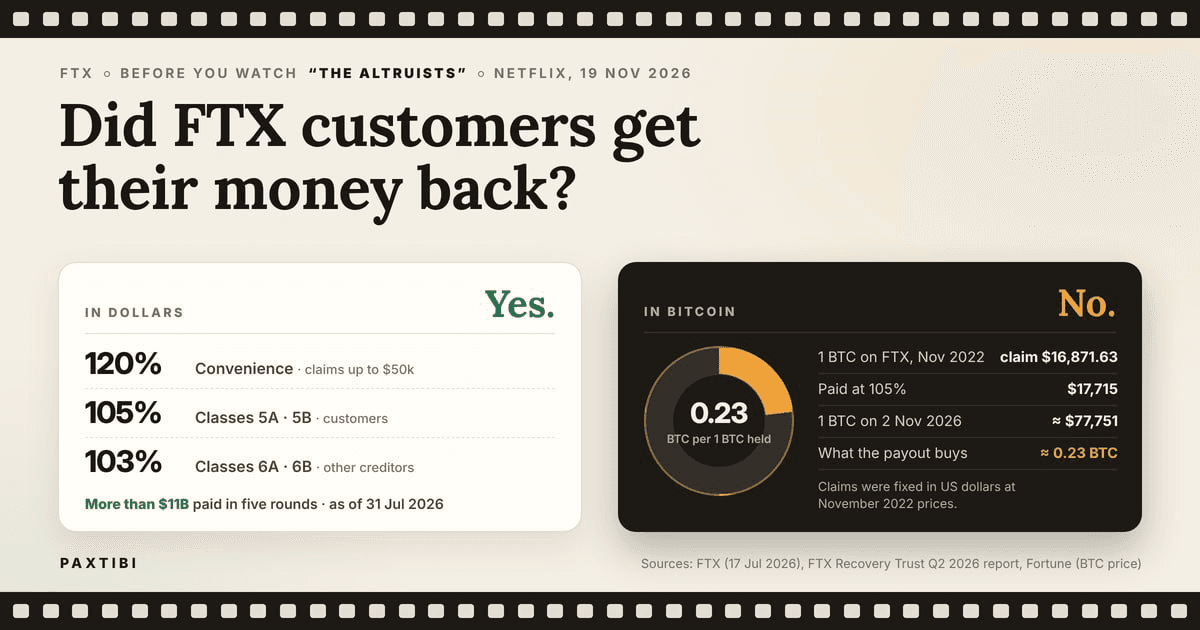
In dollar terms, yes, for most creditors whose claims were allowed.
Timeline:
- 11 November 2022: FTX filed for bankruptcy;
- October 2024: the court confirmed its repayment plan;
- February 2025: the first distribution was paid.
After the fifth round on 31 July 2026, FTX reports these cumulative payments:
| Class | Who | Paid so far |
|---|---|---|
| Convenience | Claims up to $50,000 (or reduced to it) | 120% |
| 5A | FTX.com (international) customers | 105% |
| 5B | FTX US customers | 105% |
| 6A | General unsecured creditors | 103% |
| 6B | Digital asset loan claims | 103% |
Source: FTX, 17 July 2026. Percentages are of the allowed claim.
Four points behind the table:
- The base is the November 2022 dollar value. Each customer claim was set at the account’s value in US dollars on the bankruptcy date. Amounts above 100% come from interest under the plan.
- The total is $11.2 billion. The Trust’s report for the quarter ended 30 September 2026 shows $11.2 billion paid on creditor claims. Of that, $10.55 billion went to general unsecured claims, which include customer claims.
- Not everyone was paid. Claims without KYC were struck off, and creditors in restricted countries cannot receive payouts directly. See “What to check now” below.
- What the bankruptcy cost. Professional fees and expenses from before the plan was confirmed in October 2024 total $972.6 million for the debtors and the creditor committees, according to the same report.
Why “more than 100%” is not getting your bitcoin back
The claims are in dollars, at prices from the bankruptcy date.
- The prices. FTX’s court-approved Digital Assets Conversion Table valued one bitcoin at $16,871.63 and one SOL at $16.24.
- Today. Bitcoin is worth several times more.
- The payout. Creditors are paid the dollar value of the claim, not the coins they held.
Example: one bitcoin held on FTX in November 2022.
| Amount | |
|---|---|
| Claim value at the bankruptcy-date price | $16,871.63 |
| Paid so far at 105% (classes 5A and 5B) | about $17,715 |
| Paid at 120% (Convenience) | about $20,246 |
| Price of 1 BTC on 2 November 2026 | about $77,751 |
| What the 105% payment buys today | about 0.23 BTC |
To buy back the same bitcoin, a customer would need about 461% of the claim. Our calculator runs the same comparison for BTC, ETH and SOL.
There is an irony here:
- The estate’s assets grew. Its venture stakes, such as the one in Anthropic, and its crypto holdings rose with the market. That growth is part of why creditors receive more than 100% in dollars.
- The claims did not. They stayed fixed at 2022 prices.
The appeal court on “everyone was repaid”. In June 2026 the US Court of Appeals for the Second Circuit upheld the founder’s fraud conviction and 25-year sentence.
- It rejected the defence that FTX held enough assets “to ultimately make investors and customers whole”.
- Following a 2025 Supreme Court ruling, the court held that fraud does not require the victim to suffer a net loss.
What is still to come
- The sixth distribution. Not announced as of 3 November 2026. Our estimate, not FTX’s: a record date around mid-December 2026 and a payment around late January 2027. Convenience claims were paid in a single payment. The further rounds are for larger claims.
- Interest has stopped. Per the Trust’s Q2 2026 report, interest on claims stopped accruing on 31 July 2026, so the amount still owed on each claim no longer grows.
- Disputed claims. The Trust holds back a reserve for claims still in dispute: about $1.8 billion after the June 2026 reduction. As disputes are resolved, the money not needed is released to allowed claims.
- Litigation. Binance: the $1.76 billion clawback case continues after a July 2026 ruling. Genesis Digital Assets: the $1.15 billion suit was dropped with prejudice in June 2026, and no terms were disclosed.
- Court dates. Omnibus hearings in the FTX case are scheduled for: 19 November 2026, the day the series premieres; 17 December 2026.
- Quarterly reporting. The Trust filed its post-confirmation report for the quarter ended 30 September 2026 on 21 October 2026 (D.I. 36748). Part 3 records approximately $11.225 billion in cumulative payments across the listed creditor categories, including $908.6 million paid to general unsecured claims during Q3. The same table lists $14.04 billion of total anticipated payments under the plan for general unsecured claims, of which $10.55 billion had been paid: about $3.49 billion is still anticipated. The report does not say when. This U.S. Trustee form is distinct from the Trust’s detailed financial statements: it does not provide detailed asset-sale or litigation-recovery figures.
- Why 96% and not 105%? The report shows 96% paid against allowed general unsecured claims, below the 103–120% FTX reports by class. The report does not explain the difference. Our reading: part of it is money held back for creditors who have not completed KYC, the tax form or Step 8, who live in restricted countries, or whose claims were allowed after the last record date. If that may be you, see the checklist below.
Does the pardon request affect FTX payouts?
No.
- The application. In June 2026 FTX’s founder, who is serving a 25-year sentence, applied for a presidential pardon through the Justice Department’s Office of the Pardon Attorney.
- The White House. According to press reports, the President said in a January 2026 interview that he had no plans to pardon him. After the filing, the White House pointed back to those remarks.
- The Supreme Court. Separately, the founder has asked the US Supreme Court to hear his case (No. 26-349). After two extensions, the government’s response is due on 16 December 2026.
Neither changes what creditors receive:
- Different cases. A pardon covers a federal criminal conviction. FTX creditors are paid in the civil bankruptcy case, under a plan the court confirmed in October 2024.
- Different money. The FTX Recovery Trust pays creditors from the estate’s assets: cash, sold investments and litigation recoveries. A pardon would not reopen the plan, change allowed claims or reverse payments already made.
- A precedent. Binance’s founder was pardoned in October 2025. FTX’s civil case against him still went ahead: in July 2026 the court let the clawback claims proceed.
Were you an FTX customer? What to check now
The series will remind many people that they once had an FTX account. Some never finished the claims process. Check these steps:
- Find your Unique Customer Code. Search your inbox for “FTX - Your Scheduled Claim Information and Unique Customer Code”.
- Log in at claims.ftx.com and check Step 5. Your claim must be “Allowed” to be paid.
- KYC. The deadlines have passed: in 2025, more than 390,000 claims were expunged because KYC was never started; the last deadline for a group of unverified claims was 30 June 2026. If your claim was expunged, no distributions are paid on it.
- Tax form (Step 7). Submit it within 90 days of FTX’s first notice after a record date. Otherwise that round’s payment is forfeited.
- Distribution provider (Step 8). Choose BitGo, Kraken or Payoneer within six months of the distribution date: about 31 January 2027 for the July 2026 round. Otherwise, FTX says, you may forfeit your right to receive distributions on that claim. If your country is restricted, see our list of restricted jurisdictions.
- Watch for scams. Expect fake “FTX recovery” offers after the premiere. FTX says it will never ask you to connect a wallet. Do not pay upfront fees. Never share your portal login.
Wait or sell?
If your claim is allowed, you have two options:
- Keep it and wait for further rounds. If you prefer this, ask us about payment processing.
- Sell it and be paid now. Paxtibi buys FTX claims: a written offer within 24 hours; payment at signing; we pay the $28 court fee for the transfer.
After a sale, future distributions go to the buyer, including any money from the Binance case. Our guide explains each step.
Our take
“The Altruists” will show how the money disappeared. The court record shows how most of it came back: in dollars, at 2022 prices, two to four years later. Two groups of customers lost the most:
- those who held crypto that has since risen;
- those who never completed KYC.
If you were an FTX customer, check your claim now rather than after the series ends. The Step 8 deadline for the July 2026 round is about 31 January 2027.
FAQ
Did FTX customers get their money back?
In US dollars, most creditors with allowed claims have received more than 100%: 120% for Convenience claims, 105% for classes 5A and 5B and 103% for classes 6A and 6B (FTX, as of 31 July 2026). Claims are valued at November 2022 prices, so customers who held crypto got back much less than their coins are worth today.
Why does a 105% payout not mean I got my bitcoin back?
FTX valued each claim in dollars on the bankruptcy date, at $16,871.63 per bitcoin. At about $77,750 per bitcoin on 2 November 2026, a 105% payment buys roughly 0.23 BTC for each bitcoin held on FTX.
Does the pardon request of FTX’s founder affect FTX payouts?
No. A pardon covers a federal criminal conviction. FTX creditors are paid by the FTX Recovery Trust from the estate’s assets under the bankruptcy plan the court confirmed in October 2024.
Is “The Altruists” a documentary?
No. It is a scripted eight-episode drama that premieres on Netflix on 19 November 2026. For what creditors were actually paid, rely on FTX’s announcements and the bankruptcy court record.
I had an FTX account and never followed up. What should I do?
Find your Unique Customer Code, log in at claims.ftx.com and check whether your claim is allowed. The KYC deadlines have passed. If your claim is allowed, complete the tax form (Step 7) and choose a distribution provider (Step 8) within six months of each distribution date.
Sources
- FTX, announcement of the fifth distribution, 17 July 2026
- FTX Recovery Trust, Q2 2026 financial report (D.I. 36154, filed 17 August 2026), Notes 11 and 12
- FTX: Distributions Dashboard FAQs (tax form and provider deadlines)
- Kroll docket, Case 22-11068 D.I. 30042: expungement of claims without KYC, 2025; D.I. 35557: order of 11 May 2026; D.I. 36065: notice of expungement, 31 July 2026; D.I. 35851: reserve reduction, 22 June 2026.
- US Bankruptcy Court for the District of Delaware, Opinion and Order in Adv. Pro. 24-50222, 24 July 2026
- Netflix Tudum, “The Altruists”
- United States v. Bankman-Fried — US Court of Appeals for the Second Circuit, opinion of 12 June 2026, No. 24-961-cr, 179 F.4th 104
- ABC News, report on the appeal ruling, 4 August 2026
- Bloomberg Law, report on the pardon application, June 2026
- US Supreme Court, docket No. 26-349
- Fortune, bitcoin price on 2 November 2026
- Cryptonews, petition-date prices in FTX’s conversion table
- FTX Recovery Trust, Q3 2026 post-confirmation report (D.I. 36748, filed 21 October 2026), Part 3, page 7
Disclaimer: this article is for information only and is not legal, tax or financial advice. Paxtibi buys bankruptcy claims and offers payment processing, so we have a commercial interest in this topic.